Black Book (***1/2)
(Zwartboek)
It's been about a week and a half now since I saw this, so it's not completely fresh in my mind, but this is in World War II era espionage-type triller directed by Paul Verhoeven, aka the dude who made Robocop. All of the characters speak their native languages, and so the film is subtitled with English, Dutch, German, and Hebrew all being spoken.
The film's protagonist is Rachel Stein, a Jewish woman hiding out in the countryside in the Netherlands during German occupation. She decides to flee on a boat which takes passengers to liberated territory under cover of darkness. The boat, however, is quickly discovered by a German patrol boat and its passengers are gunned down, with only Rachel escaping. The remainder of the film follows Rachel as she attempts to aid the Dutch resistance movement, while also trying to discover what happened the night the boat was discovered. As part of this effort, she seduces a German S.S. officer and begins working at the local Gestapo headquarters under an assumed name.
The film is probably not the most profound movie ever made about World War II, but it does do an excellent job of painting a portrait of the Netherlands during and immediately after World War II, and makes a number of interesting social commentaries. But moreso than that, the film really works as a thriller, and Rachel's elaborate double agent role leads to a number of tremendously tense scenes. Black Book is easily worth a watch.

Sunday, June 17, 2007

Monday, June 04, 2007
PotC: At World's End
Pirates of the Caribbean: At World's End (**)
The Pirates movies have been perhaps not the most important movies made as of late, but they have worked as entertaining escapist adventure movies. The third leg of the trilogy, At World's End, however tries to do way too much, and ends up being more exhausting than anything else. Even though there was a significant cliffhanger at the end of the second film leading into At World's End, in many ways the first two films were basically self-contained. Curse of the Black Pearl centered around Jack Sparrow and company facing off against Barbosa's crew for the cursed Aztec treasure, while Dead Man's Chest centered around Jack's debt to Davy Jones and the Flying Dutchman. In contrast, At World's End's plot is incredibly complex, incorporating characters from both of the two films, who create a number of entangling and changing alliances with each other. I don't know if the last two films were planned out when the first was created, but watching this movie, some of the new things revealed about the characters certainly seem forced to try and fit them into this web of intrigue. All this would be well and good if it added up to something great at the end, but the film's climax, nor any other part of it, is really any more exciting than the sequences that the first two movies culminated with after much less set-up.
If you've seen the first movie you know that (highlight) Jack is dead, and that Barbosa and company are setting out to find him and bring him back. The movie begins with them in Singapore stealing maps to "Davy Jones' locker" to accomplish this task. They meet Chow-Yun Fat, who is sort of wasted as a largely uninteresting pirate captain local to Singapore. They, of course, eventually find Jack, but not before a surrealistic scene of Jack in a sort of purgatory which is mildly amusing but which goes on for way too long. The movie gets more ridiculous from there, as the British navy and the East India Company tries to use Davy Jones and the Flying Dutchman as an enforcer for their own aims. Barbosa and Jack decide that a conference needs to be held with the nine Pirate captains from all over the world to try and stop them, lest pirates become extinct. The entire notion of a pirate council seems too far over the top. The series obviously never attempted to be realistic, but when all the pirates gather around a table in their own crazy looking, stereotypical ethic costumes it almost reaches self-parody (and yes, Keith Richards is in it).
Jack is still funny, the action is still visually cool, and there are a lot of moments which put a smile on your face, but the attempt at adding multiple plot twists and creating a huge web of entangling alliances between the characters is just a bad idea. What results is a convoluted plot that detracts from the simple sense of adventure which is the reason why the series is popular for people other than the 13-year old Jack Sparrow demographic. The movie's run time is three hours, which was fine for an epic like Lord of the Rings, but just exhausting in this case.
The Pirates movies have been perhaps not the most important movies made as of late, but they have worked as entertaining escapist adventure movies. The third leg of the trilogy, At World's End, however tries to do way too much, and ends up being more exhausting than anything else. Even though there was a significant cliffhanger at the end of the second film leading into At World's End, in many ways the first two films were basically self-contained. Curse of the Black Pearl centered around Jack Sparrow and company facing off against Barbosa's crew for the cursed Aztec treasure, while Dead Man's Chest centered around Jack's debt to Davy Jones and the Flying Dutchman. In contrast, At World's End's plot is incredibly complex, incorporating characters from both of the two films, who create a number of entangling and changing alliances with each other. I don't know if the last two films were planned out when the first was created, but watching this movie, some of the new things revealed about the characters certainly seem forced to try and fit them into this web of intrigue. All this would be well and good if it added up to something great at the end, but the film's climax, nor any other part of it, is really any more exciting than the sequences that the first two movies culminated with after much less set-up.
If you've seen the first movie you know that (highlight) Jack is dead, and that Barbosa and company are setting out to find him and bring him back. The movie begins with them in Singapore stealing maps to "Davy Jones' locker" to accomplish this task. They meet Chow-Yun Fat, who is sort of wasted as a largely uninteresting pirate captain local to Singapore. They, of course, eventually find Jack, but not before a surrealistic scene of Jack in a sort of purgatory which is mildly amusing but which goes on for way too long. The movie gets more ridiculous from there, as the British navy and the East India Company tries to use Davy Jones and the Flying Dutchman as an enforcer for their own aims. Barbosa and Jack decide that a conference needs to be held with the nine Pirate captains from all over the world to try and stop them, lest pirates become extinct. The entire notion of a pirate council seems too far over the top. The series obviously never attempted to be realistic, but when all the pirates gather around a table in their own crazy looking, stereotypical ethic costumes it almost reaches self-parody (and yes, Keith Richards is in it).
Jack is still funny, the action is still visually cool, and there are a lot of moments which put a smile on your face, but the attempt at adding multiple plot twists and creating a huge web of entangling alliances between the characters is just a bad idea. What results is a convoluted plot that detracts from the simple sense of adventure which is the reason why the series is popular for people other than the 13-year old Jack Sparrow demographic. The movie's run time is three hours, which was fine for an epic like Lord of the Rings, but just exhausting in this case.
Stranger than Fiction
Stranger than Fiction (***1/2)
If Stranger than Fiction is remembered years from now, it'll probably be because of Will Ferrell's performance. Ferrell, known more for his loud, over-the-top, performances like in Ancorman shows that he can still be funny without yelling and running to walls, and is capable of very serious moments as well. In the film Ferrell plays Harold Crick. He works for the IRS and, even though he's quite good at it, he doesn't seem to care much for his job. He seems to aspire for more in his life, but is too timid to take any sort of initiative. Really, he's not very interesting as a movie character except for the fact that he hears a voice in his head. Not just a voice, however, but a female voice narrating his own life as it happens.
The early part of the film explores this idea. What would it be like if your life was being constantly narrated? How would it be described even when you were doing the most mundane of things? How could you possible concentrate on your life when you heard someone narrating it, and then how would your ensuing frustration be addressed by the narrator? All of this leads to some very funny scenes which, again, show that Ferrell has potential beyond some of the obnoxious characters he's famous for.
The film's real hook comes when the narrator mentions Harold's "imminent death." She doesn't mention how or why he's going to die, only that he is going to die, and soon. Harold goes to see a psychologist who tells him he's schizophrenic, leading to this exchange:
"Mr. Crick, you have a voice speaking to you."
"No, no to me. About me."
And so Harold decides that he has to find someone whose expertise is in stories. He finds English professor Jules Hilbert, played by Dustin Hoffman, who is just eccentric enough and just enough into literature to think that helping Harold might actually be possible. He suggests that Harold try and determine whether the story being narrated about him is a comedy or a tragedy, leading to some funny scenes where Harold awkwardly attempts to get to know Ana Pascal, played by Maggie Gyllenhal, a woman who Harold is enthralled with but is in many ways his opposite.
Over the course of the film it becomes apparent that the narrator in Harold's head is an actual writer named Karen Eiffel, who was once critically acclaimed, but is now trying to overcome writer's block and finish her first novel in a number of years. The movie's ending raises questions about writing, and about death in fictional stories that would seem crazy to even consider, but somewhat seem to make perfect sense in the context of the film. Would we place the same importance on art if people actually died when art portrays death? It's an interesting question.
The film's ingenious plot is what stands out most about the film, but also of note are some of the visual effects used in the film. Harold, being very much left-brained, thinks entirely about math, and as we see him go about his day, we see things he encounters and interacts with overlayed with a mosaic of numbers and diagrams. On the bonus material of the DVD, the artists who created it called it a GUI, as in the GUI of an operating system. It is a unique effect and my only complaint about it is that it isn't used consistently throughout the film, and at times when it crops up it detracts from the dialogue going on at the same time.
Stanger than Fiction is one of the more interesting comedies in recent years. Its strange but enthralling plot let's Will Ferrell create a memorable character that is both very funny and at times a genuinely sympathetic figure.
If Stranger than Fiction is remembered years from now, it'll probably be because of Will Ferrell's performance. Ferrell, known more for his loud, over-the-top, performances like in Ancorman shows that he can still be funny without yelling and running to walls, and is capable of very serious moments as well. In the film Ferrell plays Harold Crick. He works for the IRS and, even though he's quite good at it, he doesn't seem to care much for his job. He seems to aspire for more in his life, but is too timid to take any sort of initiative. Really, he's not very interesting as a movie character except for the fact that he hears a voice in his head. Not just a voice, however, but a female voice narrating his own life as it happens.
The early part of the film explores this idea. What would it be like if your life was being constantly narrated? How would it be described even when you were doing the most mundane of things? How could you possible concentrate on your life when you heard someone narrating it, and then how would your ensuing frustration be addressed by the narrator? All of this leads to some very funny scenes which, again, show that Ferrell has potential beyond some of the obnoxious characters he's famous for.
The film's real hook comes when the narrator mentions Harold's "imminent death." She doesn't mention how or why he's going to die, only that he is going to die, and soon. Harold goes to see a psychologist who tells him he's schizophrenic, leading to this exchange:
"Mr. Crick, you have a voice speaking to you."
"No, no to me. About me."
And so Harold decides that he has to find someone whose expertise is in stories. He finds English professor Jules Hilbert, played by Dustin Hoffman, who is just eccentric enough and just enough into literature to think that helping Harold might actually be possible. He suggests that Harold try and determine whether the story being narrated about him is a comedy or a tragedy, leading to some funny scenes where Harold awkwardly attempts to get to know Ana Pascal, played by Maggie Gyllenhal, a woman who Harold is enthralled with but is in many ways his opposite.
Over the course of the film it becomes apparent that the narrator in Harold's head is an actual writer named Karen Eiffel, who was once critically acclaimed, but is now trying to overcome writer's block and finish her first novel in a number of years. The movie's ending raises questions about writing, and about death in fictional stories that would seem crazy to even consider, but somewhat seem to make perfect sense in the context of the film. Would we place the same importance on art if people actually died when art portrays death? It's an interesting question.
The film's ingenious plot is what stands out most about the film, but also of note are some of the visual effects used in the film. Harold, being very much left-brained, thinks entirely about math, and as we see him go about his day, we see things he encounters and interacts with overlayed with a mosaic of numbers and diagrams. On the bonus material of the DVD, the artists who created it called it a GUI, as in the GUI of an operating system. It is a unique effect and my only complaint about it is that it isn't used consistently throughout the film, and at times when it crops up it detracts from the dialogue going on at the same time.
Stanger than Fiction is one of the more interesting comedies in recent years. Its strange but enthralling plot let's Will Ferrell create a memorable character that is both very funny and at times a genuinely sympathetic figure.
Monday, May 14, 2007
Spiderman 3
Spiderman 3 (***)
The Spiderman trilogy (although it sounds like its going end up as more than a trilogy) as a whole is a lot of fun and a worthy adaptation of the long running comic book series. The third installment, however, is the weakest of the three and more erratic and less focused than the previous two. The first two movies were fairly simple, giving Spiderman one main villain to contend with and allowing plenty of time for Peter Parker to grow as a character and his relationships with Mary Jane and Harry Osborn to develop. These relationships are in no way abandoned in Spiderman 3, but they aren't as interesting because the movie simply has too much going on.
Chief amongst my complaints is the fact that the movie has one too many villains. Where the first film had the original Green Goblin and the second had Doctor Octopus, Spiderman 3 meanders between storylines involving Harry becoming the new Green Goblin, Flint Marko (Thomas Hayden Church) becoming The Sandman, and Eddie Brock (Topher Grace) becoming Venom. None of them are really given enough time to be truly memorable, except maybe for Harry, who has had a conflict with Spiderman/Peter building since the end of the first film. Even still, Harry's part in the film seems somewhat thrown together. In his first confrontation with Peter in early the movie Harry is thrown from his glider and suffers head trauma that manages to cause him to lose his memory of most everything past the death of his father. Afterwards, Peter tries to rekindle his friendship with him, and Mary Jane comes to confide in him regarding issues with her relationship with Peter. In this way, Harry is kept close to both Peter and M.J. for the remainder of the film. This seems too convenient, even for a comic book movie.
The main players in the Venom storyline: Eddie Brock, Gwen Stacy, and the black suit that eventually becomes the entity that is Venom are all introduced fairly early in the film, but are then mostly set aside while The Sandman's origin is told and he faces Spiderman in a visually cool but somewhat anti-climactic battle. The plot then shifts back again, as Peter begins to don the black suit, date Gwen Stacy and embrace his "dark side" in a sequence that's already led to thousands of emo jokes across the internet. The bottom line is that the lack of focus on any one of these characters means that their sum total doesn't add up to anything as interesting as the grand sum of the first two movies. We learn a little about The Sandman's motivations, and certain scenes cast him in a somewhat sympathetic light, but we don't see enough of him to truly care about his characters fate, nor does he really get a chance to develop much of a personality.
Meanwhile, the creation of Venom, while true to the comics, is similarly rushed and there isn't enough tension built before the inevitable battle. The film's ending does have some emotion to it, and while room for a sequel is definitely left open, there are significant developments and it does work as the closing to a trilogy. I was bothered, however, with some of the events leading up to the climax. There is an alliance made at the end of the film that seems to have a shaky justification based on what we're shown as an audience. It seems like a scene is missing. Again, the film seems to be rushing too much and trying to hastily find connections for multiple complicated story arcs. At times it felt like the filmmakers were trying to create Spiderman 3 & 4 at the same time. There is a rumor that Sam Raimi, who directed all 3 of the films, wanted to continue focusing on villains from the early period of the comic book series and originally wanted to include the Sandman, and only the Sandman in the film. Producer Avi Arad, allegedly, then more or less forced Raimi to write in Venom to appease the fans, many of which grew up reading Venom in comics during the 1990s and saw him in the cartoon show during the same period. I'm in no position to know if this is true or false, but it certainly seems plausible.
I have laid out some major problems I had with the movie, but I don't want to act as if I completely hated it. The humor that was in the first two films is still there (including another great Bruce Campbell cameo), the action is still both technically impressive and exciting to watch, and there are still a lot of moments that put a smile on your face. Even though I feel it is a step backward I don't think it destroys what the first two films began, nor does it do injustice to the characters or to the original series. All of the films have been worth the price of admission, and the series stands at the forefront of the recent trend of comic book movies, though it may soon be overtaken when the successors to the excellent Batman Begins are released.
The Spiderman trilogy (although it sounds like its going end up as more than a trilogy) as a whole is a lot of fun and a worthy adaptation of the long running comic book series. The third installment, however, is the weakest of the three and more erratic and less focused than the previous two. The first two movies were fairly simple, giving Spiderman one main villain to contend with and allowing plenty of time for Peter Parker to grow as a character and his relationships with Mary Jane and Harry Osborn to develop. These relationships are in no way abandoned in Spiderman 3, but they aren't as interesting because the movie simply has too much going on.
Chief amongst my complaints is the fact that the movie has one too many villains. Where the first film had the original Green Goblin and the second had Doctor Octopus, Spiderman 3 meanders between storylines involving Harry becoming the new Green Goblin, Flint Marko (Thomas Hayden Church) becoming The Sandman, and Eddie Brock (Topher Grace) becoming Venom. None of them are really given enough time to be truly memorable, except maybe for Harry, who has had a conflict with Spiderman/Peter building since the end of the first film. Even still, Harry's part in the film seems somewhat thrown together. In his first confrontation with Peter in early the movie Harry is thrown from his glider and suffers head trauma that manages to cause him to lose his memory of most everything past the death of his father. Afterwards, Peter tries to rekindle his friendship with him, and Mary Jane comes to confide in him regarding issues with her relationship with Peter. In this way, Harry is kept close to both Peter and M.J. for the remainder of the film. This seems too convenient, even for a comic book movie.
The main players in the Venom storyline: Eddie Brock, Gwen Stacy, and the black suit that eventually becomes the entity that is Venom are all introduced fairly early in the film, but are then mostly set aside while The Sandman's origin is told and he faces Spiderman in a visually cool but somewhat anti-climactic battle. The plot then shifts back again, as Peter begins to don the black suit, date Gwen Stacy and embrace his "dark side" in a sequence that's already led to thousands of emo jokes across the internet. The bottom line is that the lack of focus on any one of these characters means that their sum total doesn't add up to anything as interesting as the grand sum of the first two movies. We learn a little about The Sandman's motivations, and certain scenes cast him in a somewhat sympathetic light, but we don't see enough of him to truly care about his characters fate, nor does he really get a chance to develop much of a personality.
Meanwhile, the creation of Venom, while true to the comics, is similarly rushed and there isn't enough tension built before the inevitable battle. The film's ending does have some emotion to it, and while room for a sequel is definitely left open, there are significant developments and it does work as the closing to a trilogy. I was bothered, however, with some of the events leading up to the climax. There is an alliance made at the end of the film that seems to have a shaky justification based on what we're shown as an audience. It seems like a scene is missing. Again, the film seems to be rushing too much and trying to hastily find connections for multiple complicated story arcs. At times it felt like the filmmakers were trying to create Spiderman 3 & 4 at the same time. There is a rumor that Sam Raimi, who directed all 3 of the films, wanted to continue focusing on villains from the early period of the comic book series and originally wanted to include the Sandman, and only the Sandman in the film. Producer Avi Arad, allegedly, then more or less forced Raimi to write in Venom to appease the fans, many of which grew up reading Venom in comics during the 1990s and saw him in the cartoon show during the same period. I'm in no position to know if this is true or false, but it certainly seems plausible.
I have laid out some major problems I had with the movie, but I don't want to act as if I completely hated it. The humor that was in the first two films is still there (including another great Bruce Campbell cameo), the action is still both technically impressive and exciting to watch, and there are still a lot of moments that put a smile on your face. Even though I feel it is a step backward I don't think it destroys what the first two films began, nor does it do injustice to the characters or to the original series. All of the films have been worth the price of admission, and the series stands at the forefront of the recent trend of comic book movies, though it may soon be overtaken when the successors to the excellent Batman Begins are released.
Wednesday, May 02, 2007
Hot Fuzz plus 2 other short reviews
Hot Fuzz (***1/2)
Hot Fuzz is a loving tribute to the genre of over-the-top, Michael Bay style, explosive-filled cop dramas. The type of movie where physics and probability are of little to no consequence, and the main character always winds up the hero despite usually recklessly endangering dozens of people. It does for these sorts of movies what Shaun of the Dead did for zombie movies, which makes sense because it was written, directed, and acted by many of the same people.
The movie centers around Nicolas Angel, a cop in London who gets transferred to a one-horse down out in the country, simply because he's too good. He has a tireless devotion to his job and the best arrest record on the force, so much so that he's making everyone else looks bad. As the film begins, he tries to get accustomed to his new home of Sandford, meeting the various folksy inhabitants and his new co-workers. The police force in Sandford is much more lackadaisical, and understandably so, as there isn't much to do in the small town. Nicolas tries to shake off being such a fish out of water, and applies his knowledge from his London beat to his new assignment but it really doesn't work well. Where he used to be chasing down fleeing criminals, he now finds himself chasing around escaped swans. Futhermore, he finds himself frustrated with his well intentioned but mostly incompetent new parter, Danny.
The beginning of the movie is funny in its own right. Nicolas and Danny play off each other well, and all of the eccentric townspeople are-- one of which is a mustached Timothy Dalton--are great. But what the movie is going to be remembered for is its last half hour, where it intentionally becomes every bit as ridiculous as Bad Boys II and all the other movies its parodying with a series of preposterous action scenes. Nicolas eventually finds something is amiss in Sandford, and he has to set things right in the traditional Michael Bay/Jerry Bruckheimer fashion. In a mere half hour, there are countless quotable one-liners and applause-inducing "Oh ****!" moments. It is absolutely spot on as a parody and is going to be referenced for years to come as one of the funniest sequences to any movie.
I think the last half hour really works because the movie up to that point is so docile. It's the payoff at the end after we've gotten to know some of the characters, and their relationships have been developed a little bit. They could've made the entire movie as ridiculous as the ending and created sort of a new Naked Gun, but while the Naked Gun movies are hilarious in their own right, I don't think it would've worked as well in this case. The fact that the premise of the movie is initially more or less plausible makes the shenanigans at the end that much funnier. The entire movie builds to the end, and it delivers in every way. Hot Fuzz is a smart, well-written comedy that's probably going to become a cult classic alongside it's predecessor Shaun of the Dead.
The Weather Man (**1/2)
This is a movie starring Nicolas Cage as a David Spritz, a downtrodden, recently divorced, middle-aged man working as a TV weather man in Chicago. Some parts of the movie are written better than others. There's a few memorable lines and Nicolas Cage's narration in particular is great, but there are a few scenes where conversations seem kind of forced and awkward. Probably the strongest point of the movie is a great performance by Michael Caine as David's father.
Attack the Gas Station! (**1/2)
Uh... yeah, I wasn't really sure what to make of this. This is a Korean film from 1999 about a group of teenagers who, quite literally, attack a gas station. They rob it and hold people hostage, but more as a sign of rebellion against society than for any sort of monetary gain. There are a few flashbacks explaining how each of them were somehow wronged by a parent or an authority figure, or somehow had their dreams crushed. But really, beyond this, the movie basically just documents what happens as these four people try and torment the legitimate employees (and gang members who inexplicable show up) while trying to maintain the illusion that they're actually running the gas station themselves. Some of this is pretty amusing and it's an enjoyable watch, I'm just not sure if the broader stuff about the troubled past of each of the characters really adds up to anything except a flimsy pretext for why they're attacking a gas station.
Hot Fuzz is a loving tribute to the genre of over-the-top, Michael Bay style, explosive-filled cop dramas. The type of movie where physics and probability are of little to no consequence, and the main character always winds up the hero despite usually recklessly endangering dozens of people. It does for these sorts of movies what Shaun of the Dead did for zombie movies, which makes sense because it was written, directed, and acted by many of the same people.
The movie centers around Nicolas Angel, a cop in London who gets transferred to a one-horse down out in the country, simply because he's too good. He has a tireless devotion to his job and the best arrest record on the force, so much so that he's making everyone else looks bad. As the film begins, he tries to get accustomed to his new home of Sandford, meeting the various folksy inhabitants and his new co-workers. The police force in Sandford is much more lackadaisical, and understandably so, as there isn't much to do in the small town. Nicolas tries to shake off being such a fish out of water, and applies his knowledge from his London beat to his new assignment but it really doesn't work well. Where he used to be chasing down fleeing criminals, he now finds himself chasing around escaped swans. Futhermore, he finds himself frustrated with his well intentioned but mostly incompetent new parter, Danny.
The beginning of the movie is funny in its own right. Nicolas and Danny play off each other well, and all of the eccentric townspeople are-- one of which is a mustached Timothy Dalton--are great. But what the movie is going to be remembered for is its last half hour, where it intentionally becomes every bit as ridiculous as Bad Boys II and all the other movies its parodying with a series of preposterous action scenes. Nicolas eventually finds something is amiss in Sandford, and he has to set things right in the traditional Michael Bay/Jerry Bruckheimer fashion. In a mere half hour, there are countless quotable one-liners and applause-inducing "Oh ****!" moments. It is absolutely spot on as a parody and is going to be referenced for years to come as one of the funniest sequences to any movie.
I think the last half hour really works because the movie up to that point is so docile. It's the payoff at the end after we've gotten to know some of the characters, and their relationships have been developed a little bit. They could've made the entire movie as ridiculous as the ending and created sort of a new Naked Gun, but while the Naked Gun movies are hilarious in their own right, I don't think it would've worked as well in this case. The fact that the premise of the movie is initially more or less plausible makes the shenanigans at the end that much funnier. The entire movie builds to the end, and it delivers in every way. Hot Fuzz is a smart, well-written comedy that's probably going to become a cult classic alongside it's predecessor Shaun of the Dead.
The Weather Man (**1/2)
This is a movie starring Nicolas Cage as a David Spritz, a downtrodden, recently divorced, middle-aged man working as a TV weather man in Chicago. Some parts of the movie are written better than others. There's a few memorable lines and Nicolas Cage's narration in particular is great, but there are a few scenes where conversations seem kind of forced and awkward. Probably the strongest point of the movie is a great performance by Michael Caine as David's father.
Attack the Gas Station! (**1/2)
Uh... yeah, I wasn't really sure what to make of this. This is a Korean film from 1999 about a group of teenagers who, quite literally, attack a gas station. They rob it and hold people hostage, but more as a sign of rebellion against society than for any sort of monetary gain. There are a few flashbacks explaining how each of them were somehow wronged by a parent or an authority figure, or somehow had their dreams crushed. But really, beyond this, the movie basically just documents what happens as these four people try and torment the legitimate employees (and gang members who inexplicable show up) while trying to maintain the illusion that they're actually running the gas station themselves. Some of this is pretty amusing and it's an enjoyable watch, I'm just not sure if the broader stuff about the troubled past of each of the characters really adds up to anything except a flimsy pretext for why they're attacking a gas station.
Monday, April 02, 2007
300
300 (***)
I don't really feel the need to write a huge review for this. The story is more or less based on the historical battle of Thermopylae, but the story is basically a loose outline between huge, stylized fight scenes. Like the trailer, characters yell a lot of stuff dramatically, but the dialogue is really not all that important. Visually, the movie is amazing. Like Sin City, it's a testament to how CGI can be used to create otherwise impossible settings, without being loud and obnoxious and distracting from the human performances.
300 is in no way as deep of a work as Sin City. Sin City was just as stylized and violent, but each of its main characters went through a tremendous amount of development throughout their respective stories. While 300 follows its hero Leonitis, from his childhood up to his famous last stand, it's first and foremost about the battle itself and not about giving any deep insights about his character. But it's impossible not to find the fighting badass, and in the end that's really all you need for a movie to be entertaining enough to be worth the price of admission. If you like action movies, you'll like 300.
I don't really feel the need to write a huge review for this. The story is more or less based on the historical battle of Thermopylae, but the story is basically a loose outline between huge, stylized fight scenes. Like the trailer, characters yell a lot of stuff dramatically, but the dialogue is really not all that important. Visually, the movie is amazing. Like Sin City, it's a testament to how CGI can be used to create otherwise impossible settings, without being loud and obnoxious and distracting from the human performances.
300 is in no way as deep of a work as Sin City. Sin City was just as stylized and violent, but each of its main characters went through a tremendous amount of development throughout their respective stories. While 300 follows its hero Leonitis, from his childhood up to his famous last stand, it's first and foremost about the battle itself and not about giving any deep insights about his character. But it's impossible not to find the fighting badass, and in the end that's really all you need for a movie to be entertaining enough to be worth the price of admission. If you like action movies, you'll like 300.
Friday, March 23, 2007
Breach
Breach (***)
Breach is based on a true story, and follows the investigation and eventual arrest of Robert Hanssen, "the worst spy in U.S. history" as he is described in the movie. Before a case was finally built against him in 2001, Hanssen worked in the FBI, and sold huge amounts of classified information to which he had access. The movie begins with a young FBI agent, played by Ryan Phillippe, getting the assignment of posing as his new clerk, essentially distracting him enough to allow for his possessions to be sifted through for evidence.
Hanssen is played by Chris Cooper, who portrays him as an arrogant, controlling, super type-A personality sort of figure. He constantly talks down to Phillippe's character, Eric O'Neill, treating him as an errand boy, despite seeming to have a certain respect for his talents. At the same time, Hanssen is (or at least seems to be) a very pious and traditional Catholic. A good part of the film deals with Hanssen attempting to become sort of a father figure and spiritual advisor to O'Neill, which puts him at odds with O'Neill's non-practicing wife, who knows Hanssen only as O'Neill's boss and not as a man under investigation.
Over the course of the movie, the FBI attmpts several ploys using O'Neill to gather evidence from Hanssen's car and his PDA, amoung other things. Gradually, O'Neill becomes frustrated and somewhat paranoid of the constantly suspicious Hanssen. The film's biggest moments of suspense are examples of O'Neill having to think on his toes to weave through precarious situations where he has to stay in character as Hanssen's loyal assistant and yet at the same constantly distract him from the searches taking place around him.
The movie is worthwhile because Hanssen is an interesting character and Chris Cooper's performance is very good, but the film never really builds a tremendous amount of tension, despite the espianoge and spy games that are central to the story. The movie never seems to make up its mind as to whether it's trying to be a triller and focus on the actual circumstances of Hanssen's treason and O'Neill's investigation, or to be a movie focused on the subtleties of Hanssen's character. At many times it seems to be the latter. There are several scenes of Hanssen in mass, which he claims he goes to on a daily basis, which would seem to suggest that the movie is trying to focus on the apparent hypocracy of his character. But in the last act of the film there are two scenes which seem like they're trying to be climax of a Jason Bourne, Jack Ryan type of espionage movie. Because so much of the film before this point has been so introspective of Hanssen, they don't have the tension you would expect them to have. The movie as a whole seems somewhat slow-going and unexciting, especially considering the gravity of what both main characters are involved in. The film is interesting, but doesn't seem to exact all the potential from the true story on which it is based.
--EK
Breach is based on a true story, and follows the investigation and eventual arrest of Robert Hanssen, "the worst spy in U.S. history" as he is described in the movie. Before a case was finally built against him in 2001, Hanssen worked in the FBI, and sold huge amounts of classified information to which he had access. The movie begins with a young FBI agent, played by Ryan Phillippe, getting the assignment of posing as his new clerk, essentially distracting him enough to allow for his possessions to be sifted through for evidence.
Hanssen is played by Chris Cooper, who portrays him as an arrogant, controlling, super type-A personality sort of figure. He constantly talks down to Phillippe's character, Eric O'Neill, treating him as an errand boy, despite seeming to have a certain respect for his talents. At the same time, Hanssen is (or at least seems to be) a very pious and traditional Catholic. A good part of the film deals with Hanssen attempting to become sort of a father figure and spiritual advisor to O'Neill, which puts him at odds with O'Neill's non-practicing wife, who knows Hanssen only as O'Neill's boss and not as a man under investigation.
Over the course of the movie, the FBI attmpts several ploys using O'Neill to gather evidence from Hanssen's car and his PDA, amoung other things. Gradually, O'Neill becomes frustrated and somewhat paranoid of the constantly suspicious Hanssen. The film's biggest moments of suspense are examples of O'Neill having to think on his toes to weave through precarious situations where he has to stay in character as Hanssen's loyal assistant and yet at the same constantly distract him from the searches taking place around him.
The movie is worthwhile because Hanssen is an interesting character and Chris Cooper's performance is very good, but the film never really builds a tremendous amount of tension, despite the espianoge and spy games that are central to the story. The movie never seems to make up its mind as to whether it's trying to be a triller and focus on the actual circumstances of Hanssen's treason and O'Neill's investigation, or to be a movie focused on the subtleties of Hanssen's character. At many times it seems to be the latter. There are several scenes of Hanssen in mass, which he claims he goes to on a daily basis, which would seem to suggest that the movie is trying to focus on the apparent hypocracy of his character. But in the last act of the film there are two scenes which seem like they're trying to be climax of a Jason Bourne, Jack Ryan type of espionage movie. Because so much of the film before this point has been so introspective of Hanssen, they don't have the tension you would expect them to have. The movie as a whole seems somewhat slow-going and unexciting, especially considering the gravity of what both main characters are involved in. The film is interesting, but doesn't seem to exact all the potential from the true story on which it is based.
--EK
Monday, March 19, 2007
The Prestige
The Prestige (****)
Off the heels of directing the excellent Batman Begins, Christopher Nolan directed The Prestige, a film with a very different subject, but which not only has the same dark visuals, but is equally enticing. The film follows magicians in 1890s London, played by Christian Bale and Hugh Jackman, who are somewhat different in technique, but are both at the top of their profession. Jackman's character has mastered the acting and the showmanship required to hook an audience, while Christian Bale's character has mastered the actual innerworkings of the illusions, in part because of his total devotion to his craft.
The two men are connected by a man named Cutter, played by the always ridiculously cool Michael Caine, who serves as a mentor and maybe a bit of a father figure to both of them. An incident occurs causing the illusionists to dispise each other. They engage in a riviarly where each sabotage's the other's performances, in part to physically hurt the other, and in part to show their superiority in sleight of hand. The rivialry comes to a head when Christian Bale's character, Alfred Borden, debuts his "The Transported Man" trick, where he is seemingly able to walk through a door and walk through another on the opposite side of the stage within a fraction of a second. Robert Angier, Jackman's character, becomes obsessed with the seemingly flawless illusion, dismissing Cutter's claim that the man who emerges from the second door is simply an excellent body double.
Angier's obessive quest for the secret of the illusion leads him across the pond to America, and more specifcally to Colorado Springs. It is against this snowy backdrop that Nolan displays some hauntingly beautiful visuals, which represent the very best of the film's overall excellent cinematography. Angier travels to Colorado to visit the eccentric scientist Nikola Tesla, played by the homo superior himself, David Bowie. Angier presses him about the possibilities of teleportation, convinced that Borden's illusion is rooted in science, and not just deception. It is here that the film takes a turn towards science fiction. This could've been extremely campy and ruined the entire film, but Nolan's direction and the screenplay (which was written by Nolan and his brother, Johnathan) gives it a sense of legitimacy and makes it all work.
At the beginning of the film, Cutter explains in a voice over that a magic trick consists of three parts: the pledge, the turn, and the prestige. These scenes with Tesla would certainly represent the film's "turn" if it can be said to have one. What began as a film about two men in a professional and personal rivalry, becomes a deeply philosophical film with much more universal themes. The film's "prestige" then, is its revealing ending, which again, could have played out in a very B-movie way, but is handled excellently. Some people probably won't be thrown off by the end reveal (I don't consider myself that good at guessing plots before they play out and I partially predicted the events of the ending correctly, though I didn't have an explanation for them) but I think most everyone will find it compelling regardless.
Simply, The Prestige is a film which, on the surface follows a figurative chess match between two bitter rivals, and on quite another level provides a study of depecption and of human nature. Either way you choose to look at it, it is exellent, and anyone who felt what Nolan did for Batman was a breath of fresh air for the character will certainly love his latest work.
--EK
Off the heels of directing the excellent Batman Begins, Christopher Nolan directed The Prestige, a film with a very different subject, but which not only has the same dark visuals, but is equally enticing. The film follows magicians in 1890s London, played by Christian Bale and Hugh Jackman, who are somewhat different in technique, but are both at the top of their profession. Jackman's character has mastered the acting and the showmanship required to hook an audience, while Christian Bale's character has mastered the actual innerworkings of the illusions, in part because of his total devotion to his craft.
The two men are connected by a man named Cutter, played by the always ridiculously cool Michael Caine, who serves as a mentor and maybe a bit of a father figure to both of them. An incident occurs causing the illusionists to dispise each other. They engage in a riviarly where each sabotage's the other's performances, in part to physically hurt the other, and in part to show their superiority in sleight of hand. The rivialry comes to a head when Christian Bale's character, Alfred Borden, debuts his "The Transported Man" trick, where he is seemingly able to walk through a door and walk through another on the opposite side of the stage within a fraction of a second. Robert Angier, Jackman's character, becomes obsessed with the seemingly flawless illusion, dismissing Cutter's claim that the man who emerges from the second door is simply an excellent body double.
Angier's obessive quest for the secret of the illusion leads him across the pond to America, and more specifcally to Colorado Springs. It is against this snowy backdrop that Nolan displays some hauntingly beautiful visuals, which represent the very best of the film's overall excellent cinematography. Angier travels to Colorado to visit the eccentric scientist Nikola Tesla, played by the homo superior himself, David Bowie. Angier presses him about the possibilities of teleportation, convinced that Borden's illusion is rooted in science, and not just deception. It is here that the film takes a turn towards science fiction. This could've been extremely campy and ruined the entire film, but Nolan's direction and the screenplay (which was written by Nolan and his brother, Johnathan) gives it a sense of legitimacy and makes it all work.
At the beginning of the film, Cutter explains in a voice over that a magic trick consists of three parts: the pledge, the turn, and the prestige. These scenes with Tesla would certainly represent the film's "turn" if it can be said to have one. What began as a film about two men in a professional and personal rivalry, becomes a deeply philosophical film with much more universal themes. The film's "prestige" then, is its revealing ending, which again, could have played out in a very B-movie way, but is handled excellently. Some people probably won't be thrown off by the end reveal (I don't consider myself that good at guessing plots before they play out and I partially predicted the events of the ending correctly, though I didn't have an explanation for them) but I think most everyone will find it compelling regardless.
Simply, The Prestige is a film which, on the surface follows a figurative chess match between two bitter rivals, and on quite another level provides a study of depecption and of human nature. Either way you choose to look at it, it is exellent, and anyone who felt what Nolan did for Batman was a breath of fresh air for the character will certainly love his latest work.
--EK
The Last King of Scotland
The Last King of Scotland (***1/2)
The Last King of Scotland begins with Nicolas Gerrigan, a recently graduated med student in Scotland, perhaps unwilling to follow in his father's footsteps as a physician, deciding to travel somewhere at random. He ends up picking Uganda, follows through with it, and ends up working as a doctor at a mission there. He meets a married woman working there, played by Gillian Anderson, and nearly seduces her into an affair. But his travels take a drastic turn shorter thereafter, as he treats Idi Amin, the new Ugandan president (read: oppressive dictator), who injures his hand in a car accident. Distracted while treating the injury, Gerrigan shoots and kills a noisy and apparently injured cow using Amin's own pistol. Amin, impressed by his initiative and fearlessness, oppoints Gerrigan as his personal physician.
Slowly, Gerrigan's job as Amin's physician morphs into a job as his political advisior, as Amin becomes increasingly impressed with Gerrigan's character as he gets to know him more. Amin puts a great amount of trust in Gerrigan, partly because, being from Scotland, Amin feels Gerrigan somehow shares a distrust of the British, a feeling Amin developed as a boy growing up under British occupation. Gerrigan is, at first, a loyal lackey, hinging on every word Amin says about improving Uganda's infastructure, and gratefully accepting Amin's lavish gifts. It is only late in the film, and after Gerrigan has made several crucial mistakes, that he begins to piece together the gruesome reality of Amin's Ugandan revolution.
Forrest Whittaker won an Oscar for the film, and his performance is clearly the strong point. Whittaker at times shows Amin's charismatic facade that drew Gerrigan in, and at other times is nothing short of terrifying. Near the end of the film, as world opinion is turning sharply against Amin, and Gerrigan is administering him uppers to get him through the day, Whittaker simultaneously shows his almost pathetic state of frustration, and his enduring and frightening vengefullness.
The movie's main weakness is Gerrigan's character. It has nothing to do with the performance of James McAvoy who does a very good job opposite of Whittaker. But the film doesn't do a great job selling Gerrigan and how he gets into such a tumultuous position. The Gerrigan character is ficticious and a composite of several characters from the novel of which the film is based. At times it seems like this composite was never fully fleshed out. The film never really establishes why Gerrigan so brashly steals Amin's gun to shoot a cow and yet at other times seems as nervous and uncertain as you would expect a man barely out of college to act in unfamiliar territory. It never establishes how Gerrigan appears to be as well-studied and composed as a seasoned doctor, and yet seems so naive and oblivious to much of anything else going on. I've never read the novel, but judging by the issues with Gerrigan's character, I can guess that the film may have benefitted from staying closer to the original work.
The Last King of Scotland clearly is not flawless, but Forrest Whittaker's performance alone makes the film worth watching. Furthermore, the film does an excellent job of documenting the rise and fall of Amin, one of many figures in Africa who caused the deaths of many, and yet is much less infamous than he would be had he existed in the "first world." In this way, The Last King of Scotland is invaluable.
--EK
The Last King of Scotland begins with Nicolas Gerrigan, a recently graduated med student in Scotland, perhaps unwilling to follow in his father's footsteps as a physician, deciding to travel somewhere at random. He ends up picking Uganda, follows through with it, and ends up working as a doctor at a mission there. He meets a married woman working there, played by Gillian Anderson, and nearly seduces her into an affair. But his travels take a drastic turn shorter thereafter, as he treats Idi Amin, the new Ugandan president (read: oppressive dictator), who injures his hand in a car accident. Distracted while treating the injury, Gerrigan shoots and kills a noisy and apparently injured cow using Amin's own pistol. Amin, impressed by his initiative and fearlessness, oppoints Gerrigan as his personal physician.
Slowly, Gerrigan's job as Amin's physician morphs into a job as his political advisior, as Amin becomes increasingly impressed with Gerrigan's character as he gets to know him more. Amin puts a great amount of trust in Gerrigan, partly because, being from Scotland, Amin feels Gerrigan somehow shares a distrust of the British, a feeling Amin developed as a boy growing up under British occupation. Gerrigan is, at first, a loyal lackey, hinging on every word Amin says about improving Uganda's infastructure, and gratefully accepting Amin's lavish gifts. It is only late in the film, and after Gerrigan has made several crucial mistakes, that he begins to piece together the gruesome reality of Amin's Ugandan revolution.
Forrest Whittaker won an Oscar for the film, and his performance is clearly the strong point. Whittaker at times shows Amin's charismatic facade that drew Gerrigan in, and at other times is nothing short of terrifying. Near the end of the film, as world opinion is turning sharply against Amin, and Gerrigan is administering him uppers to get him through the day, Whittaker simultaneously shows his almost pathetic state of frustration, and his enduring and frightening vengefullness.
The movie's main weakness is Gerrigan's character. It has nothing to do with the performance of James McAvoy who does a very good job opposite of Whittaker. But the film doesn't do a great job selling Gerrigan and how he gets into such a tumultuous position. The Gerrigan character is ficticious and a composite of several characters from the novel of which the film is based. At times it seems like this composite was never fully fleshed out. The film never really establishes why Gerrigan so brashly steals Amin's gun to shoot a cow and yet at other times seems as nervous and uncertain as you would expect a man barely out of college to act in unfamiliar territory. It never establishes how Gerrigan appears to be as well-studied and composed as a seasoned doctor, and yet seems so naive and oblivious to much of anything else going on. I've never read the novel, but judging by the issues with Gerrigan's character, I can guess that the film may have benefitted from staying closer to the original work.
The Last King of Scotland clearly is not flawless, but Forrest Whittaker's performance alone makes the film worth watching. Furthermore, the film does an excellent job of documenting the rise and fall of Amin, one of many figures in Africa who caused the deaths of many, and yet is much less infamous than he would be had he existed in the "first world." In this way, The Last King of Scotland is invaluable.
--EK
Saturday, March 10, 2007
Wednesday, March 07, 2007
Bad song lyrics of the day #2
"It's like a deadly game of freeze tag,
I touch you with a 44 mag and you're frozen inside a body bag"
--Dr. Dre and Ice Cube - "Natural Born Killers"
I touch you with a 44 mag and you're frozen inside a body bag"
--Dr. Dre and Ice Cube - "Natural Born Killers"
Monday, March 05, 2007
Bad song lyrics of the day #1
"Invisible kid
Locked away in his brain
From the shame and the pain
World down the drain
Invisible kid
Suspious of your touch
Don't want no crutch
But it's all too much"
--Metallica - Invisible Kid
I fully intend on making this a recurring thing for some reason. Most of them are probably going to be from this album.
Locked away in his brain
From the shame and the pain
World down the drain
Invisible kid
Suspious of your touch
Don't want no crutch
But it's all too much"
--Metallica - Invisible Kid
I fully intend on making this a recurring thing for some reason. Most of them are probably going to be from this album.
Thursday, February 15, 2007
Fearless
Fearless (***1/2)
Fearless tells the story of Huo Yuan Jia (which is actually the film's original title), a renowned Chinese wushu master who competed during the beginning of the 20th century and formed a school which still exists internationally today. Huo Yuan Jia is played by Jet Li, supposedly acting in his final martial arts film at the age of 44. The film follows Huo from early in his life up until his death, and in this way is a very focused and personal film. At the same time, however, the film ties Huo's rise to national fame to China's desperate need for national pride, during a time when foreign governments had begun openly exploiting the country, and its once subservient neighbor of Japan had begun to force its will upon it.
The first half of the film begins with Huo as a youth aspiring to be like his father-- also a wushu mater-- and following him as he gains notoriety as a fighter himself and founds his martial arts school. This first act culminates in a bloody confruntation with another wushu master who injured one of his students. After this, the film transitions into a more relaxed interlude where Huo goes into a self-imposed exile in a rural farming community. This segment has no fighting and very little dialogue, but still contains some of the more poignant scenes in the film, as Huo meets a blind woman with whom he seems to develop an unspoken bond.
As beautiful as some of these scenes are, Fearless is clearly going to be remembered first and foremost for its fighting. Supposedly, very few wires were used in Fearless's filming, and its evident. The fighting is raw, fast, and intense and the full range of Jet Li's martial arts prowess is shown. The movie culminates in a scene in which Jet Li fights four different international fighters with four different fighting styles, with each fight having at least one "That kicked ass" moment. The film is going to be remembered for a long time amongst fans of martial arts movies.
Fearless is only a little over an hour and a half long, and the scenes setting up the political intrigue and cultural backdrop surrounding the fighting seem sort of barebones. There aren't any exchanges of dialogue that are going to be incredibly memorable-- save perhaps a scene where Huo philosophizes with a Japanese sword fighter-- and the vilification of the foreign characters seems somewhat over the top even in their limited time on screen. Still, the film's incredible fight sequences and beautiful fight scenes speak volumes even if the dialogue sometimes does not. And indeed, the most powerful statement of the film during the climactic fight requires no words whatsoever.
If Fearless is indeed Jet Li's last martial arts film, it is a good way to go out.
Fearless tells the story of Huo Yuan Jia (which is actually the film's original title), a renowned Chinese wushu master who competed during the beginning of the 20th century and formed a school which still exists internationally today. Huo Yuan Jia is played by Jet Li, supposedly acting in his final martial arts film at the age of 44. The film follows Huo from early in his life up until his death, and in this way is a very focused and personal film. At the same time, however, the film ties Huo's rise to national fame to China's desperate need for national pride, during a time when foreign governments had begun openly exploiting the country, and its once subservient neighbor of Japan had begun to force its will upon it.
The first half of the film begins with Huo as a youth aspiring to be like his father-- also a wushu mater-- and following him as he gains notoriety as a fighter himself and founds his martial arts school. This first act culminates in a bloody confruntation with another wushu master who injured one of his students. After this, the film transitions into a more relaxed interlude where Huo goes into a self-imposed exile in a rural farming community. This segment has no fighting and very little dialogue, but still contains some of the more poignant scenes in the film, as Huo meets a blind woman with whom he seems to develop an unspoken bond.
As beautiful as some of these scenes are, Fearless is clearly going to be remembered first and foremost for its fighting. Supposedly, very few wires were used in Fearless's filming, and its evident. The fighting is raw, fast, and intense and the full range of Jet Li's martial arts prowess is shown. The movie culminates in a scene in which Jet Li fights four different international fighters with four different fighting styles, with each fight having at least one "That kicked ass" moment. The film is going to be remembered for a long time amongst fans of martial arts movies.
Fearless is only a little over an hour and a half long, and the scenes setting up the political intrigue and cultural backdrop surrounding the fighting seem sort of barebones. There aren't any exchanges of dialogue that are going to be incredibly memorable-- save perhaps a scene where Huo philosophizes with a Japanese sword fighter-- and the vilification of the foreign characters seems somewhat over the top even in their limited time on screen. Still, the film's incredible fight sequences and beautiful fight scenes speak volumes even if the dialogue sometimes does not. And indeed, the most powerful statement of the film during the climactic fight requires no words whatsoever.
If Fearless is indeed Jet Li's last martial arts film, it is a good way to go out.
Tuesday, January 02, 2007
Movies I saw in 2006
The following are lists ranking all the films that have been released in the past 3 years. It'll be updated periodically.
2006 Movies
1. The Departed
2. V for Vendetta
3. Casino Royale
4. Thank You for Smoking
5. The Prestige
6. Inside Man
7. An Inconveinent Truth
8. A Scanner Darkly
9. Stranger than Fiction
10. Borat
11. Clerks II
12. Little Miss Sunshine
13. The Last King of Scotland
14. Fearless
15. Pirates of the Carribean: Dead Man’s Chest
Superman Returns
Lucky Number Slevin
Crank
Nacho Libre
X-Men: The Last Stand
2005 Movies
1. Good Night and Good Luck
2. Crash
3. Downfall
4. Sin City
5. Batman Begins
6. Oldboy
7. King Kong
8. Kung Fu Hustle
9. Syriana
10. A History of Violence
11. Millions
12. Proof
13. Star Wars: Episode III
14. Kicking & Screaming
15. Kiss Kiss Bang Bang
The Producers
Mr. and Mrs. Smith
Hitchhiker’s Guide to the Galaxy
Charlie and the Chocolate Factory
War of the Worlds
The Pacifier
2004 Movies
1. Million Dollar Baby
T-2. House of Flying Daggers
T-2. Hero
3. The Aviator
4. Kill Bill 2
5. The Life Aquatic
6. Ray
7. The Terminal
8. Spiderman 2
9. Collateral
10. The Bourne Supremacy
11. Hellboy
12. Garden State
13. Zatoichi: The Blind Swordsman
14. Anchorman
15. Napolean Dynomite
16. Supersize Me
17. Fahrenheit 9\11
18. Dodgeball
19. Harold & Kumar Go To White Castle
20. Team America
Starsky and Hutch
Van Helsing
Alien vs. Predator
Saw
2006 Movies
1. The Departed
2. V for Vendetta
3. Casino Royale
4. Thank You for Smoking
5. The Prestige
6. Inside Man
7. An Inconveinent Truth
8. A Scanner Darkly
9. Stranger than Fiction
10. Borat
11. Clerks II
12. Little Miss Sunshine
13. The Last King of Scotland
14. Fearless
15. Pirates of the Carribean: Dead Man’s Chest
Superman Returns
Lucky Number Slevin
Crank
Nacho Libre
X-Men: The Last Stand
2005 Movies
1. Good Night and Good Luck
2. Crash
3. Downfall
4. Sin City
5. Batman Begins
6. Oldboy
7. King Kong
8. Kung Fu Hustle
9. Syriana
10. A History of Violence
11. Millions
12. Proof
13. Star Wars: Episode III
14. Kicking & Screaming
15. Kiss Kiss Bang Bang
The Producers
Mr. and Mrs. Smith
Hitchhiker’s Guide to the Galaxy
Charlie and the Chocolate Factory
War of the Worlds
The Pacifier
2004 Movies
1. Million Dollar Baby
T-2. House of Flying Daggers
T-2. Hero
3. The Aviator
4. Kill Bill 2
5. The Life Aquatic
6. Ray
7. The Terminal
8. Spiderman 2
9. Collateral
10. The Bourne Supremacy
11. Hellboy
12. Garden State
13. Zatoichi: The Blind Swordsman
14. Anchorman
15. Napolean Dynomite
16. Supersize Me
17. Fahrenheit 9\11
18. Dodgeball
19. Harold & Kumar Go To White Castle
20. Team America
Starsky and Hutch
Van Helsing
Alien vs. Predator
Saw
Saturday, November 25, 2006
Hey, I'm back
Well, I haven't used this in about... four months, but whatever. I saw a couple of excellent movies recently that I feel the need to write about.
The Departed (****)
The Departed is a movie about organized crime, a subject that Martin Scorsese has made movies about before, but The Departed has a distinctly different feel to it than any of his other films, though its every bit as good. It is apparently loosely based on a Hong Kong cop drama from a few years back called Infernal Affairs. The central characters are two men who are each moles in their respective organizations: one a police detective feeding information to the mob, the other an undercover cop who has infiltrated the mafia. But the man who steals the spotlight is Jack Nichelson as the head of the mob organization. At times he's hilarous, at other times he's stone cold scary. It's a great performance that could become as referenced as his Joker performance in the original Batman.
Unlike Raging Bull, which jumps from a number of key points in Jake Lamotta's career and then holds there, allowing scenes with long conversations between characters to play out, The Departed has a much more fluid and dynamic feel to it that really works for the film. Scenes are often very quick and we jump back and forth very quickly from the police to the mob and back again. Trying it all together is a great soundtrack in which the same music is often allowed to play over the course of several distinctly different scenes. The effect keeps the tension driving and provides a glue to connect for very frantically paced scenes. In a way, it actually reminded me of the way the anime series Fooly Cooly used its soundtrack provided by the band The Pillows. The Departed is a different sort of Martin Scorsese movie, but a great one.
Casino Royale (***1/2)
Die Another Day sucked. I feel the need to express that up front. The James Bond series has always had some level of absurdity to it, but by Die Another Day it had reached a tipping point where it felt to absurd, even for Bond (somewhere around the point where he managed to outrun a heat ray from space in his Aston Martin, which could also turn invisible). Apparently realizing this, the filmmakers behind Casino Royale wisely took the film on a different tangent. In a way, Casino Royale is the Batman Begins for the Bond franchise. A lot of the ridiculous fluff has been stripped away, allowing for the focus to be left on the core elements of the series, and of the Bond character itself.
Casino Royale wastes no time distancing itself from previous Bond movies, even forgoing the famous "blood dripping down the gun barrel" opening briefly to make room for a gritty, black and white flashback sequence where Bond kills two people in a fairly merciless faschion. The scene establishes a darker, more sinister side of Bond that hadn't existed in recent films. I haven't read the original Ian Fleming novel, but I'm told that the film stays resonably true to the story, with many of changes being necessary ones for purposes of updating the setting from the early cold war, to post 9/11. The middle act of the movie revolves entirely around the high-stakes poker game (baccaract in the book) that Bond enters into to counter Le Chiffre, who is using the money to pay a terrorist organization that he has been bankrolling. This section could be brutally boring, but the filmmakers do an excellent job of adding just enough intrigue outside of the game itself to keep the tension moving without being a complete distraction.
The new Bond girl is Vesper Lind, played by Eva Green. Vesper is much smarter and more independant than the average Bond girl, something they actually tried with Halle Berry's character Jinx in Die Another Day and failed miserably by comparison. Vesper is also unique among women in Bond movies for several other reasons, firstly that Bond seems to have genuine feelings for her beyond her being another girl of the evening, and the other reasons involve plot points that I won't give away.
Casino Royale is a great action film that keeps things exciting while focusing on its characters rather than prop gadgets and special effects. It establishes Danial Craig as an excellent new Bond, who is every bit as witty as previous iterations, while adding an aura of edgyness and intimidation that hasn't existed for a long time. After Die Another Day, I wasn't sure if I wanted to see another Bond movie again, after Casino Royale, I wish the next Bond was out already.
The Departed (****)
The Departed is a movie about organized crime, a subject that Martin Scorsese has made movies about before, but The Departed has a distinctly different feel to it than any of his other films, though its every bit as good. It is apparently loosely based on a Hong Kong cop drama from a few years back called Infernal Affairs. The central characters are two men who are each moles in their respective organizations: one a police detective feeding information to the mob, the other an undercover cop who has infiltrated the mafia. But the man who steals the spotlight is Jack Nichelson as the head of the mob organization. At times he's hilarous, at other times he's stone cold scary. It's a great performance that could become as referenced as his Joker performance in the original Batman.
Unlike Raging Bull, which jumps from a number of key points in Jake Lamotta's career and then holds there, allowing scenes with long conversations between characters to play out, The Departed has a much more fluid and dynamic feel to it that really works for the film. Scenes are often very quick and we jump back and forth very quickly from the police to the mob and back again. Trying it all together is a great soundtrack in which the same music is often allowed to play over the course of several distinctly different scenes. The effect keeps the tension driving and provides a glue to connect for very frantically paced scenes. In a way, it actually reminded me of the way the anime series Fooly Cooly used its soundtrack provided by the band The Pillows. The Departed is a different sort of Martin Scorsese movie, but a great one.
Casino Royale (***1/2)
Die Another Day sucked. I feel the need to express that up front. The James Bond series has always had some level of absurdity to it, but by Die Another Day it had reached a tipping point where it felt to absurd, even for Bond (somewhere around the point where he managed to outrun a heat ray from space in his Aston Martin, which could also turn invisible). Apparently realizing this, the filmmakers behind Casino Royale wisely took the film on a different tangent. In a way, Casino Royale is the Batman Begins for the Bond franchise. A lot of the ridiculous fluff has been stripped away, allowing for the focus to be left on the core elements of the series, and of the Bond character itself.
Casino Royale wastes no time distancing itself from previous Bond movies, even forgoing the famous "blood dripping down the gun barrel" opening briefly to make room for a gritty, black and white flashback sequence where Bond kills two people in a fairly merciless faschion. The scene establishes a darker, more sinister side of Bond that hadn't existed in recent films. I haven't read the original Ian Fleming novel, but I'm told that the film stays resonably true to the story, with many of changes being necessary ones for purposes of updating the setting from the early cold war, to post 9/11. The middle act of the movie revolves entirely around the high-stakes poker game (baccaract in the book) that Bond enters into to counter Le Chiffre, who is using the money to pay a terrorist organization that he has been bankrolling. This section could be brutally boring, but the filmmakers do an excellent job of adding just enough intrigue outside of the game itself to keep the tension moving without being a complete distraction.
The new Bond girl is Vesper Lind, played by Eva Green. Vesper is much smarter and more independant than the average Bond girl, something they actually tried with Halle Berry's character Jinx in Die Another Day and failed miserably by comparison. Vesper is also unique among women in Bond movies for several other reasons, firstly that Bond seems to have genuine feelings for her beyond her being another girl of the evening, and the other reasons involve plot points that I won't give away.
Casino Royale is a great action film that keeps things exciting while focusing on its characters rather than prop gadgets and special effects. It establishes Danial Craig as an excellent new Bond, who is every bit as witty as previous iterations, while adding an aura of edgyness and intimidation that hasn't existed for a long time. After Die Another Day, I wasn't sure if I wanted to see another Bond movie again, after Casino Royale, I wish the next Bond was out already.
Friday, July 28, 2006
Clerks II

Clerks II
***1/2
Clerks II doesn't have the same indy movie feel as the first film, it doesn't have the same deep philosophical conversations, and it doesn't have the same emotional weight to it... but damn is it funny. Clerks II shows once again what most people already know, that Kevin Smith's films are some of the best dialogue-driven comedies out there. The movie is, in a lot of ways, in more the same category as Jay & Silent Bob Strike Back in that the humor is a lot more farcical and ridiculous, whereas the original Clerks had its fun, but tried to keep everything fairly plausible and down to earth. For example, there's a Bollywood style dance scene inexplicably thrown in the middle, among other things.
At its core, though, Clerks II, like the original, revolves around Dante and Randal. And even though its been more than a decade in between films, the characters still hold up pretty well. Dante is almost identical, save for maybe a bit less depression, while Randal doesn't seem to age quite as well. Some of the outrageous stuff Randal says-- and it is at least equally as ridiculous as anything from the original-- somehow seems less funny and maybe a little creepy now that the character is supposed to be 32. Despite this, Randal still has a number of laugh out loud moments, and he steals the movie with one bit in particular toward the end that I won't give away.
Clerks II takes place during Dante's last day at Mooby's before he moves to Florida with his fiance, the fast food joint where Dante and Randal go to work after the Quick Stop burns down in an accident. Rosario Dawson plays their boss and does an excellent job playing a character that probably has the most deadpan serious dialgoue in a movie with a lot of ridiculous gas. She develops an interesting relationship with Dante, and not just interesting because she's not his finace. Jay and Silent Bob make their requisit appearances and... basically are Jay and Silent Bob. There is another newcomer, Elias, a devotly relgious 19-year old whose main concerns are Transformers and Lord of the Rings. His main purpose is to be a whipping boy for Randal, but he does manage to have some funny moments of his own, and Kevin Smith's dialgoue brings the whole thing to another level beyond the traditional "watch the nerd get abused" scene.
Not everything works in Clerks II. You've probably seen the trailer which shows a donkey at one point. Yeah, it's pretty much what you think it is, and where the scene is going is blantly obvious from the get-go, but it gets drawn on way too long. But again, most of the movie is genuinely funny, and if you laughed at all at any of Kevin Smith's other films Clerks II is a must-see.
Wednesday, June 21, 2006
Dark City
Dark City
****

I blind bought this at Fry's because it was a scant $5.88 for the DVD and, wow, I'm glad I did. I absolutly ate this movie up. The inevitable question "What's it about?" is a hard question to answer without giving a lot away, but you can draw a lot of parallels between this film and The Matrix which was made one year later, only, as cool as the Matrix was, I think in some ways this is an even better film.
The film takes place entirely within a city (which is indeed dark) where mysterious pale creatures that wear fedoras known as Strangers fly around and use their telepathic powers to alter reality (no, seriously). If you watch The Venture Brothers on Adult Swim, the guys roaming around the courthouse that Brock calls Strangers in the Trail of the Monarch episode are taken right from this movie.
As the movie opens, we see a man awaken in his bathtub to find a dead woman in his apartment. He is frightened and confused, and realizes that he has no memory of who he is. He recieves a phone call from a strange man telling him that he'd been expiramented on. The man turns out to be a goofy looking psychiatrist who walks with a limp, played by Keifer Sutherland. He is the human assistant of the Strangers, helping them in expiraments on such subjects as the protagonist. As part of the entire process, every night at midnight, every human in the city loses conciousness and time seemingly freezes and the Strangers combine their power to reorganize the city. Buildings appear and disappear and different people wind up in different places, but when they regain conciousness the next day they don't seem to find anything out of place. In one instance, a newsstand is run by one man one night and a different man the next, though the second man claims he's worked there for 25 years. The Strangers run into a problem when John, the protagonist, stays awake during the "tuning" as they call it.
The bulk of the film follows John as he tries to reconnect his past, while at the same time learning bits and pieces regarding the nature and purpose of what it is that the Strangers do. There is a subplot with a detective, played by William Hurt, as he tries to solve the murder in John's apartment and several others with the same pattern. Hurt's character is straight out of the 40's detective movie tradition, like Maltiese Falcon, and many of the visuals are out of the same ilk. The city is very gothic looking, a little bit like the Tim Burton Batman films, and it takes on a life of its own, both literally as the Strangers alter it every night, and figuratively in a countless amount of imaginative shots. About every 30 seconds there was something visually that jumped out at me that made me say "Oh, that's cool." The film is only 90 minutes long, but it seems like they packed about 3 hours worth of shots into the movie somehow and they're all great to look at. The movie supposedly is very similar to Metropolis, which I haven't seen, but I have seen M, by the same director, and I think it's fair to say that there's a lot of M in this movie as well.
Basically, if you're looking for something to watch, go out and buy this movie. For 6 bucks it's hard to really go wrong with this.
****
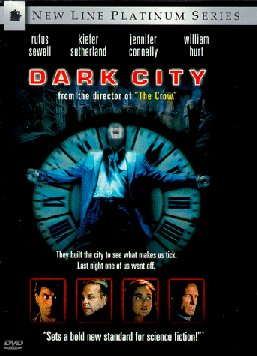
I blind bought this at Fry's because it was a scant $5.88 for the DVD and, wow, I'm glad I did. I absolutly ate this movie up. The inevitable question "What's it about?" is a hard question to answer without giving a lot away, but you can draw a lot of parallels between this film and The Matrix which was made one year later, only, as cool as the Matrix was, I think in some ways this is an even better film.
The film takes place entirely within a city (which is indeed dark) where mysterious pale creatures that wear fedoras known as Strangers fly around and use their telepathic powers to alter reality (no, seriously). If you watch The Venture Brothers on Adult Swim, the guys roaming around the courthouse that Brock calls Strangers in the Trail of the Monarch episode are taken right from this movie.
As the movie opens, we see a man awaken in his bathtub to find a dead woman in his apartment. He is frightened and confused, and realizes that he has no memory of who he is. He recieves a phone call from a strange man telling him that he'd been expiramented on. The man turns out to be a goofy looking psychiatrist who walks with a limp, played by Keifer Sutherland. He is the human assistant of the Strangers, helping them in expiraments on such subjects as the protagonist. As part of the entire process, every night at midnight, every human in the city loses conciousness and time seemingly freezes and the Strangers combine their power to reorganize the city. Buildings appear and disappear and different people wind up in different places, but when they regain conciousness the next day they don't seem to find anything out of place. In one instance, a newsstand is run by one man one night and a different man the next, though the second man claims he's worked there for 25 years. The Strangers run into a problem when John, the protagonist, stays awake during the "tuning" as they call it.
The bulk of the film follows John as he tries to reconnect his past, while at the same time learning bits and pieces regarding the nature and purpose of what it is that the Strangers do. There is a subplot with a detective, played by William Hurt, as he tries to solve the murder in John's apartment and several others with the same pattern. Hurt's character is straight out of the 40's detective movie tradition, like Maltiese Falcon, and many of the visuals are out of the same ilk. The city is very gothic looking, a little bit like the Tim Burton Batman films, and it takes on a life of its own, both literally as the Strangers alter it every night, and figuratively in a countless amount of imaginative shots. About every 30 seconds there was something visually that jumped out at me that made me say "Oh, that's cool." The film is only 90 minutes long, but it seems like they packed about 3 hours worth of shots into the movie somehow and they're all great to look at. The movie supposedly is very similar to Metropolis, which I haven't seen, but I have seen M, by the same director, and I think it's fair to say that there's a lot of M in this movie as well.
Basically, if you're looking for something to watch, go out and buy this movie. For 6 bucks it's hard to really go wrong with this.
Monday, June 05, 2006
Crazy People
Bill O'Reilly owned. I salute you Keith Olberman.
Also, Pat Robertson says he can bench press 2,000 pounds.
Also, Pat Robertson says he can bench press 2,000 pounds.
Saturday, May 27, 2006
X-Men 3
X-Men 3
**
The first X-Men movie was decent. It was a little rough around the edges, but it did a great job of introducing the characters and the main themes that have always been at the core of X-Men stuff. Then Brian Singer took everything that working in X-Men and built off of it to create X2, which is right up there with the best superhero movies made during this recent wave of them. There were some amazing FX sequences, but at its hart, what made X2 really work was that it made you care about the characters. It did a great job of accentuating the bigotry and persecution that the X-Men have faced throughout their history, especially through Brian Cox's fantastic villain William Stryker.
Now with Singer off to direct Superman Returns, Brett Ratner has stepped for X-Men 3: The Last Stand (as a sidenote, was this honestly the best subtitle they could come up with). Ratner tries to remain faithful to the precedents set by Singer in the first two chapters, but ultimate it feels like he created "X-Men Lite." By that I mean it sets up as much if not more story than the first two, but never really lets any of it develop, instead giving way to big action scenes, which, though they look impressive, are not necessary at all in many cases. The movie only runs for about an hour and 45 minutes, almost half an hour shorter than X2, supposedly in part because of how much filiming was rushed to get the movie out in time for Memorial Day. In this short space the movie tries to tell both the film version of the Dark Phoenix saga that was hinted at by the end of the 2nd film, while also following another plot regarding a "mutant cure" being developed. The movie never really slows down to give either of these story lines the exposition they need, and the movie ends up feeling very disjointed and not very emotionally hitting.
SPOILERS FROM THIS POINT ON
I didn't find much of the story incredibly effective, but the entire subplot with Jean Grey seemingly ressurected as the Phoenix was a complete mess. I didn't think it was absolutely necessary for the next movie just because of the one shot of the Phoenix in the water from X2's ending, and trying to cram it into this movie when its already trying to go in a totally different direction with the mutant cure premise was clearly a mistake. None of the stuff from the original comic book version of the Phoenix saga involving aliens and spaceships was included because the audience wouldn' t buy it, but the explanation given here is no less absurd. At the showing I was at there was audible laughter as Professor X explains how Jean Grey "wrapped herself in a cacoon of telekenetic energy." He then vaults himself into a big explanation about psychic barriers in Jean's head evidently somehow giving her multiple personally disorder. All of this would've been fine with me if we were allowed to see more of what's going on in Jean Grey's head, but in the next scene we see of Jean Grey break out of the X-Men and basically totally succumb to the Phoenix side of her personality. Before she's captured, we see her arise from the water at Alkali Lake and attack Scott. We see like a 2 second shot of Scott apparently being hurt and then later an explanation by Wolverine that he suspects that she killed him, but that's it. Cyclops is the leader of the X-Men and is at the forefront of both of the previous two films, and yet he's killed in an emotionless scene maybe 20 minutes into the film. This point is entirely ignored until we see a brief shot of his grave next to Jean's at the very end of the movie. Really, the Phoenix effect didn't really work for me. They tried to give Jean a very demonic sort appearance with the help of some CGI, but I thought it was one of the least effective effects in a movie that really had some pretty good ones.
Ian McKellon is good again as Magneto, and he manages to at least keep his side of the story fairly interesting. Magneto has always been an effective villain because he doesn't see himself as one, and there are several good scenes to that effect in X-Men 3, like when he takes the stage at an underground mutant rally trying to convince its audience that the so-called voluntary mutant cure will actually be used to exterminate the mutant population. Kelsey Grammer wasn't bad as The Beast, but not much was done with him. People would weren't familiar at all with X-Men would've gotten the whole "he looks really scary, but he's actually really smart" concept, but that's about it and The Beast is a much deeper character than that.
The movie does have some good moments. The opening scene with a much younger Professor X and Eric Leinshier going to visit Jean Grey was a good scene to get the audience primed again for the X-Men universe after a couple years layoff since X2. I thought the scene where Logan fights his way up to Jean and kills her not only looked cool, but was probably the most moving scene of the movie (in comparision to Professor X's death, where he just sort of shatters into a million pieces in a fairly cheesy effect).
The movie's ending(s) in particular left a bad taste in my mouth. Firstly, we see Magneto seemingly able to move a metal chess piece just as the credits begin to roll. If you remove the last shot of Magneto moving the piece, I think it becomes an excellent scene that brings the tragedy of his character full circle. Instead it becomes a dime a dozen cheesy cliff-hanger ending. Then for good measure they added an "after the credits" scene where it is implied at Professor X is still alive. I think its also very much noteworthy that Scott's dead body is never seen, nor anything to suggest to the audience "Yeah, he's gone for good." Watching the ending I could almost hear the studio execs sitting around saying "Okay, we need to leave ourselves an out in case we want to make X-Men 4."
Is X-Men 3 a horrible movie? I would say no (I do know some people who would say a resounding yes). The climactic action sequences genuinely did hold my interest, and it retained at least a glimmer of what made the Singer movies work. But to me it was somewhat sloppily done, the focus seemingly more on cool special effects rather than fleshing about the story. I'm not going to pretend like SFX sequences don't make for an exicting movie because they do, but X-Men at its core for all its laser blasts and adamantium claws has always been a very human story, with ethical and philosophical issues. The sense of humanity wasn't there in this movie and it needed to be at least 20-30 minutes longer for any of the characters to properly develop. X2 will always been one of my favorite movies from this era of superhero movies, but oh what could have been with X-Men 3.
**
The first X-Men movie was decent. It was a little rough around the edges, but it did a great job of introducing the characters and the main themes that have always been at the core of X-Men stuff. Then Brian Singer took everything that working in X-Men and built off of it to create X2, which is right up there with the best superhero movies made during this recent wave of them. There were some amazing FX sequences, but at its hart, what made X2 really work was that it made you care about the characters. It did a great job of accentuating the bigotry and persecution that the X-Men have faced throughout their history, especially through Brian Cox's fantastic villain William Stryker.
Now with Singer off to direct Superman Returns, Brett Ratner has stepped for X-Men 3: The Last Stand (as a sidenote, was this honestly the best subtitle they could come up with). Ratner tries to remain faithful to the precedents set by Singer in the first two chapters, but ultimate it feels like he created "X-Men Lite." By that I mean it sets up as much if not more story than the first two, but never really lets any of it develop, instead giving way to big action scenes, which, though they look impressive, are not necessary at all in many cases. The movie only runs for about an hour and 45 minutes, almost half an hour shorter than X2, supposedly in part because of how much filiming was rushed to get the movie out in time for Memorial Day. In this short space the movie tries to tell both the film version of the Dark Phoenix saga that was hinted at by the end of the 2nd film, while also following another plot regarding a "mutant cure" being developed. The movie never really slows down to give either of these story lines the exposition they need, and the movie ends up feeling very disjointed and not very emotionally hitting.
SPOILERS FROM THIS POINT ON
I didn't find much of the story incredibly effective, but the entire subplot with Jean Grey seemingly ressurected as the Phoenix was a complete mess. I didn't think it was absolutely necessary for the next movie just because of the one shot of the Phoenix in the water from X2's ending, and trying to cram it into this movie when its already trying to go in a totally different direction with the mutant cure premise was clearly a mistake. None of the stuff from the original comic book version of the Phoenix saga involving aliens and spaceships was included because the audience wouldn' t buy it, but the explanation given here is no less absurd. At the showing I was at there was audible laughter as Professor X explains how Jean Grey "wrapped herself in a cacoon of telekenetic energy." He then vaults himself into a big explanation about psychic barriers in Jean's head evidently somehow giving her multiple personally disorder. All of this would've been fine with me if we were allowed to see more of what's going on in Jean Grey's head, but in the next scene we see of Jean Grey break out of the X-Men and basically totally succumb to the Phoenix side of her personality. Before she's captured, we see her arise from the water at Alkali Lake and attack Scott. We see like a 2 second shot of Scott apparently being hurt and then later an explanation by Wolverine that he suspects that she killed him, but that's it. Cyclops is the leader of the X-Men and is at the forefront of both of the previous two films, and yet he's killed in an emotionless scene maybe 20 minutes into the film. This point is entirely ignored until we see a brief shot of his grave next to Jean's at the very end of the movie. Really, the Phoenix effect didn't really work for me. They tried to give Jean a very demonic sort appearance with the help of some CGI, but I thought it was one of the least effective effects in a movie that really had some pretty good ones.
Ian McKellon is good again as Magneto, and he manages to at least keep his side of the story fairly interesting. Magneto has always been an effective villain because he doesn't see himself as one, and there are several good scenes to that effect in X-Men 3, like when he takes the stage at an underground mutant rally trying to convince its audience that the so-called voluntary mutant cure will actually be used to exterminate the mutant population. Kelsey Grammer wasn't bad as The Beast, but not much was done with him. People would weren't familiar at all with X-Men would've gotten the whole "he looks really scary, but he's actually really smart" concept, but that's about it and The Beast is a much deeper character than that.
The movie does have some good moments. The opening scene with a much younger Professor X and Eric Leinshier going to visit Jean Grey was a good scene to get the audience primed again for the X-Men universe after a couple years layoff since X2. I thought the scene where Logan fights his way up to Jean and kills her not only looked cool, but was probably the most moving scene of the movie (in comparision to Professor X's death, where he just sort of shatters into a million pieces in a fairly cheesy effect).
The movie's ending(s) in particular left a bad taste in my mouth. Firstly, we see Magneto seemingly able to move a metal chess piece just as the credits begin to roll. If you remove the last shot of Magneto moving the piece, I think it becomes an excellent scene that brings the tragedy of his character full circle. Instead it becomes a dime a dozen cheesy cliff-hanger ending. Then for good measure they added an "after the credits" scene where it is implied at Professor X is still alive. I think its also very much noteworthy that Scott's dead body is never seen, nor anything to suggest to the audience "Yeah, he's gone for good." Watching the ending I could almost hear the studio execs sitting around saying "Okay, we need to leave ourselves an out in case we want to make X-Men 4."
Is X-Men 3 a horrible movie? I would say no (I do know some people who would say a resounding yes). The climactic action sequences genuinely did hold my interest, and it retained at least a glimmer of what made the Singer movies work. But to me it was somewhat sloppily done, the focus seemingly more on cool special effects rather than fleshing about the story. I'm not going to pretend like SFX sequences don't make for an exicting movie because they do, but X-Men at its core for all its laser blasts and adamantium claws has always been a very human story, with ethical and philosophical issues. The sense of humanity wasn't there in this movie and it needed to be at least 20-30 minutes longer for any of the characters to properly develop. X2 will always been one of my favorite movies from this era of superhero movies, but oh what could have been with X-Men 3.
Wednesday, May 17, 2006
Dark Victory

Just finished reading Dark Victory last night and liked it a lot. It's sort of an unofficial sequel to The Long Halloween, another excellent Batman miniseries by the same creators. Like its predecessor, Dark Victory follows Batman on the trail of a serial killer, in this case targeting former acquaintences of Harvey Dent. I've always found Batamn more interesting when he's confined to Gotham City as a detective. As cool as it is seeing him fighting alongside a crapload of Justice League members in stuff like Infinite Crisis, he always seems a little out of place. It's hard to imagine Batman as anything except a lone wolf type of character.
Like Long Halloween, the mafia syndicate in Gotham is again involved and there are a lot of references taken directly out of The Godfather films. This combined with the noir sort of feel that Sale's art has gives the series a great atmosphere. The plot of Dark Victory is less convoluted than Long Halloween. There is one definite identity of the killer, and the payoff at the end when all has been revealed comes together pretty well.
Dark Victory sets itself in the year after Long Halloween, "Year Two" you could say, and thus Robin shows up towards the end of the book. His presence feels a little tacked on. The circumstances in which his parents are killed vaguely ties into the larger plot of the story, but it doesn't really feel necessary, and when he and Batman finally team up and the end of the book it doesn't really seem to have much emotion behind it. This is a very minor complaint though, and Dark Victory as a whole is every bit as enjoyable as its predecessor.
P.S.: Tim Sale's Catwoman is hot.
Subscribe to:
Posts (Atom)