Friday, March 06, 2009

Burn After Reading


This is probably going to be pretty short because its been a while now since I watched it and its not that fresh in my mind anymore, but here goes.

Burn After Reading (***)

After watching Burn After Reading on DVD, I watched a little big of the "making of..." featurette included in the Special Features which included Joel and Ethan Coen being asked how the origin of the movie came about. The Coens explained that it arose from having a bunch of separate ideas for characters specifically tailored to actors that they liked, and then they built the rest of the story to tie together these parts. Hearing this was unsurprising, firstly because the actors do clearly seem to have a lot of fun in their roles and do seem to be excellent matches for most of them, but also unsurprising because the story feels extremely haphazard and rough around the edges. It is intended to feel somewhat, because its an ensemble movie that turns into this big, interconnected comedy of errors in which no one character really knows the full extent of what's going on. But in other movies of this ilk, take for example Guy Ritchie's Snatch or Lock, Stock and Two Smoking Barrels, the movie eventually brings all of the separate storylines together at a climax where it becomes clear how everything ties in and all of the stories come to a satisfying resolution. In Burn After Reading, there definitely is a converging of storylines, and there certainly is some sense of closure to some of them--notably for one character who doesn't make it out alive--but it nevertheless doesn't feel complete at the end. The payoff, when you look back at the whole movie from its ending, isn't quite satisfactory, and though the movie tries to be clever through its various twists and turns and intertwined relationships, it doesn't have the same wit that the Coen brothers' previous forays into comedy like The Big Lebowski have in droves.

Like I said, it's been a little while now since I watched this, but from what I remember, the gist of the story goes something like this. Osbourne Cox (John Malcovich) is an easily agitated CIA Agent, who gets called into a meeting in which he finds out that he's been "reassigned" from his current job. His superiors assure him that this isn't the same as him getting fired and that they have another position lined up for him, but this is cold comfort to Osbourne, who decides he's going to leave his job on his own terms and quits. With a lot of free time now on his hands, Osbourne decides his going to write memoirs of his time in the CIA and try and get a book deal out of it. His wife, Katie (Tilda Swinton), who obviously doesn't have a lot of confidence in his ability to write an entire book, this a fairly absurd idea. Actually, Katie dislikes being with Osbourne for more than just his memoirs and is planning to divorce him, which is probably for the best because she's already secretly banging another married man, Harry Pfarrer (George Clooney). Harry, in turn, also ends up banging Linda Litzke, a woman who seems to be going through a bit of a mid-life crisis which manifests itself through her planning a bunch of plastic surgeries and trying a bunch of online dating services.

Thing is, plastic surgery costs money, of which Linda isn't swimming in from her salary as a personal trainer. As such, she is immediately interested when her co-worker, Chad Feldheimer (Brad Pitt), finds a CD with what he describes as "Some serious CIA shit with like... numbers..." in one of the locker rooms. In actuality, the CD is stuff Katie pulled off of her husband's computer. The "CIA shit" is fairly harmless information from Osbourne's memoirs, and the "numbers" are from his tax statements, information which a lawyer suggest she obtain before filing divorce papers. This never occurs to Chad and Linda, who attempt first to extort a random out of Osbourne Cox, then, when that doesn't work, try to sell the disc to the Russians, who they apparently still consider America's number one enemy. The CIA eventually gets wind of this attempted espionage, but doesn't really find out much about the whole situation, except who's sleeping with who.

Brad Pitt's character is easily the funniest part of the movie, and I'd say the movie is almost worth seeing just for his performance, even if the movie as a whole is kind of a mess. His chracter is kind of a spazz, and Pitt spends most of the movie in bicycle shorts dancing to music on his iPod or drinking out of a water bottle in the most effeminate way possible. The thing is, his character is completely ridiculous compared to the other main characters involved in the love triange (or love whatever the polygon would be for the total amount of people involved) part of the storyline. He seems more like a character that would be alongside Walter or "The Jesus" from The Big Lebowski, but the rest of the movie doesn't have the surreal quality that Lebowski has that allows you to believe that its taking place a world where those characters can exist. Which brings me back to where I started this. The movie has a lot of clever ideas, but they're clever ideas that seem to be pasted together with that crappy glue stick they give you in second grade art class that doesn't hold anything for more than about 20 seconds. Its not a terrible movie, but with what the Coen brothers have done in the past both dramatically and comedically, I expected something more polished.

I guess that didn't end up being all that short.

Monday, March 02, 2009

It's gettin' to be about that time, eh chaps?


Baseball season can't get here soon enough. Watching the Cubs get swept 3-0 in the NLDS at the hands of the Dodgers, making a 97-win regular season all for naught, was kind of like getting kicked in the nuts in super slow-motion. Neither a respectable, but not particularly memorable, 9-7 Bears season nor the possibly playoff bound, but still terrible outside of Derrick Rose Bulls have done much to take the sting away. Now here we are and February and, well, that sting is still going to be there for a while. Spring training games just started on Wednesday and we're still a good 7 weeks away from the regular season starting. And to be frank, its hard to imagine the regular season being all that satisfying an experience either. The Cubs won the NL Central pretty comfortably last year, are returning rougly the same team as last year, and the rest of an already pretty bad division would seem to have gotten substantially worse. As such, the Cubs winning the division this year wouldn't be a huge deal at all, and not winning it would represent a monumental collapse. The only thing that's going to remove the sting of getting swept in back-to-back NLDS series is going to be getting back to the playoffs and getting to the World Series. Even still, there's always a degree of excitment that comes with baseball starting up again, so let's talk about it.

Probably thanks in part to the recession, it was a pretty quiet off-season around the league with the exception of the Yankees, who threw massive piles of money at Mark Texiera and C.C. Sabathia. The Cubs are returning a roster that's largely the same at its core but its been tweaked a little bit. The two most significant losses are Mark DeRosa and Kerry Wood. Seeing Wood go is kind of bittersweet because, even with all of his injury issues he's been a member of the Cubs for a decade, and he seemed like a genuinely good guy. Although, I have to say, going to mlb.com and seeing a news story that Wood's back was bothering him and knowing that I didn't have to worry about it was something I can get used to. It seems like Carlos Marmol will be handed the reigns of the closer's job, although Kevin Gregg was brought in as well from Florida and could probably do an adequate job in a pinch. Provided Marmol doesn't have a huge breakdown (and the prospect of that is always going to scare the hell out of me so long as Lou's having him throw 40+ pitch outings and come right back the next day), the loss of Wood shouldn't be hugely crushing.

The DeRosa loss might be a bit more significant. DeRosa was brought in two years ago as a super-sub type of guy, and indeed, he's played admirably all over the field with the Cubs. Last year, though, DeRosa did more than just field a bunch of positions, he put together a career year at the plate, hitting 21 home runs and driving in 87. It would seem that, in dealing DeRosa to the Indians for pitching prospects, that the Cubs figure that DeRosa is not going to repeat that performance again (he did just turn 34), and decided to "sell high" if you will. Still, it is a little disconcerting that, to replace DeRosa, the Cubs went out and got Aaron Miles. Miles is a switch-hitter and the Cubs made it a goal to get less righty heavy after getting shut down by the right-hand dominated Dodgers pitching staff in the NLDS last year. The thing is, compared to DeRosa, even if he starts to decline, Miles isn't really all that good. He put together a .317 average last year with the Cardinals, but even still he had an OPS of .753 which was good for an OPS+ of 99 (an OPS+ of 100 represents an average hitter). The Cubs do have the left-handed Mike Fontenot, who isn't really that great either, but he's younger than Miles and I'm not convinced he'd be all that worse. The Cubs saved a little bit of money trading DeRosa and getting Miles but not all that much. I think the gap in production between DeRosa and Miles is probably wider than the gap in cost. So I think the Miles signing was somewhat dubious.

Maybe the biggest signing of the offseason for the Cubs was Milton Bradley. The reaction to the signing was immediately polarizing amongst fans, as the Cubs gave a pretty lucrative 3 year deal to a guy with undeniable hitting prowess but also with equally undeniable injury problems. Last year, Bradley had a fantastic .436 OBP with 22 HRs and 77 RBIs for the Indians in 126 games, but was used almost entirely as a DH, something which obviously isn't an option for the Cubs. You have to go all the way back to 2004 to find the last time Bradley was able to play in as many games as he did in 2008, when he appeared in 141 with the Dodgers. If he could stay healthy, the switch-hitting Bradley would likely be a huge upgade over Kosuke Fukudome, should he struggle as he did in the 2nd half of '08, but that's an enormous if. Bradley didn't exactly restore confidence in his health by leaving a spring training game with a quad injury after taking a walk in his first at-bat. It seems like the injury is pretty minor, but its hard to imagine a more ominous sign than that. The Cubs also said goodbye to backup catcher Henry Blanco and brought back Paul Bako, who caught alongside Michael Barrett for the Cubs in the '03 and '04 seasons. I don't really understand why they did this, as Blanco is the exact same age, is a slightly better hitter who every once in a while would inexplicably go on a tear offensively, and seemed to do an excellent job of handling the pitching staff. Bako, again, makes them more left-handed, but we're talking about the backup catcher here. Presumably Bako isn't going to be the first option brought in as a pinch-hitter against rightys. I dunno, this move really isn't a big deal, but I always had an irrational love for ol' Hank White.

In terms of the rotation, the Cubs re-signed Ryan Dempster who had a career year last year. He probably isn't going to repeat quite the success that he had last year, and honestly the Cubs probably paid him more than he's worth, but he seems like a genuinely good guy and he's fun to watch pitch. The Cubs also brought in Aaron Heilman from the Mets, who has split time between being a starter and a long reliever throughout his career. Heilman's numbers aren't stellar at all, but he gives them some pitching depth, which is good because its already being said that Rich Harden is going to be good for maybe 20 starts this year. The Cubs also have Sean Marshall still in their back pocket, but they haven't shown a willingness to put him in the rotation and keep him there yet, and he's going to be 26 next year. At this point you have to believe that the Cubs aren't counting on Marshall's upside being all that much more that what he's shown to this point.

Some of the moves by the Cubs are head-scratchers to an extend, but none of them seem egrigiously bad at this point. The Cubs were looking for fill-in guys, and while I'm not convinced that this group of guys is the absolute best to fill those roles, I think for the most part they'll do an adequate job, and the Cubs have a lot to fall back on this year as well. I think they may have overreacted a bit with just how crucial it was that they got more left-handed at the plate, to the point where they brought in guys like Aaron Miles who clearly weren't the best overall hitters out there, but who knows. If the Cubs run into the Dodgers again in the playoffs, which is certainly possible, those leftys may look like Godsends.

Nothing earth-shattering has happened in Spring Training thus far. Carlos Zambrano went 3 IP without allowing a run in his first start. Hopefully that suggests that he'll get off to a good start again in '09 as he did in '08, breaking a streak of a bunch of bad Aprils from years prior, but who knows. As I said, there's only so much you can read into Spring Training games. Micah Hoffpauir has been getting some ABs, and has hit a couple of home runs already. He'll probably make the roster and, hopefully, will hit a couple of those as a pinch hitter later on in the regular season.

That's all I've got for now.

Thursday, February 26, 2009

Coraline


Coraline (***1/2)

Henry Selick, the man who directed The Nightmare Before Christmas--the stop-motion animated movie which has deservedly become a cult classic--once again returns to animation to direct Coraline, a fascinating movie in a lot of different ways. Like Nightmare, its a much darker and stranger vision than most movies that are marketed as "kids" movies, and its also a lot more interesting. I didn't actually realize until after having seen the movie that its based on a children's book by Neil Gaiman of Sandman fame (aside: head down to your local comic book shop and check out "Whatever Happened to the Caped Crusader?", the Gaiman-penned two-part Batman story, the first of which is currently out as Batman #686), but now that I'm privy to that information it makes perfect sense, as it has the same brilliant juxtaposition of the mundane and the fantastical that Gaiman first perfected in Sandman. Like 2007's Beowulf, the screenplay for which was coincidentally written by Gaiman, and a lot of other recent animated movies, Coraline is presented in 3D. Unlike Beowulf, however, the 3D effects didn't annoy the hell out of me and distract me from the movie itself rather than complement it. The fact that the movie is simply a lot better probably doesn't hurt either.

Our heroine for the story is its title character, Coraline. She's an adolescent girl who moves with her parents into an old rustic house that's been split into three apartments in a secluded part of Oregon. Her parents co-publish a gardening periodical, but don't seem to spend any time doing any actual gardening, instead spending all of their time fretting over writing about it. Their devotion to their self-employment irks Coraline, who hates being ignored by them, and can't understand why they dragged her out to the middle of nowhere, away from her friends at her old school when they seem to have barely noticed the change in scenery. Her mother (voiced by Teri Hatcher) seems to have a perpetual migraine made worse every time Coraline pesters her for something, while her father (Johnathan Hodgman) seems good natured enough, but spends all of his time in his office in a not-very-ergonomically correct slouch and sporting a five-o'clock shadow, emerging only to fulfill his promise of doing the cooking for the family, even though he's terrible at cooking.

As a way to vent about all this, Coraline spends a lot of time wondering about outside. On one such occasion she runs into Wybee, a boy who lives not far away with his grandma who is something of a science geek and who inexplicably has a big metal mask with a big crank that rotates between different lenses that looks like something out of Fallout 3. Coraline is mostly annoyed by Wybee's presence (hypocritical much?), but Wybee nevertheless sends Coraline a doll from his grandma's collection that bears an eerie resemblance to her. Things get eerier when Coraline awakens one night, and discovers that a tiny doorway in the living room that was previously bricked up is now a pathway to a strange alternate reality. She's greeted there by her "other mother," who looks exactly like her actual mother except she has doll buttons sewn on her face where her eyes should be. Unlike her actual mother, this version seems all to eager to please Coraline. She also discovers her similarily button-eyed "other father," who instead of sitting in front of a computer, sits in front of a piano with mechanical hands and composes songs about Coraline. The other tenants are different too. The eastern European guy upstairs, seemingly a not-quite-all-there drunk who talks to his rats in reality, gets his rats to put on an elaborate circus performance in this world. Meanwhile, the two old retired actresses living downstairs, normally obsessed with their scottish terriers, really old hard candy, and taking pot-shots at each other about their former careers, put on a stage performance of their own in the "other world" in a giant darkened theatre lit by terriers with flashlights strapped to their heads.

As you might expect, the button-people world is not what it seems and eventually the sinister true nature of it all is revealed. Coraline is given a very creepy ultimatum by her "other mother" that would allow her to stay in the other world with all its wonders and all Coraline has to do is perform one fairly disturbing self-mutliating act, the very idea of which will scare the hell out of a lot of the kids going to see this "kids" movie. Coraline of course knows better, refuses, and becomes locked in a battle of wits with the evil spirit that controls the "other world," making it alluring to children so that she can trap them there. The climax of the story becomes very video game-ish, and the movie's final showdown between hero and villain is exciting only to a mild degree, but the overall atmophere that drives the entire move is more than enough to maintain your interest.

The atmosphere truly is the heart of the movie and what it will be remembered for, much moreso than the plot which is somewhat fun but also a little bit paint-by-numbers. The score is provided by a French composer who, according to his Wiki article, is new to American movies, but I hope he does more because I immediately fell in love with his work here. From the onset his music provides an etherial and darkly beautiful complement to Coraline's visuals. Even though a plot-point of the movie is Coraline discovering the mysterious and wonderful, "other world," the supposedly mundane world of Coraline is still pretty fantastical. The old building which Coraline's family moves into sort of looks like the Bates motel from Psycho if Psycho was in color and it was painted pink. The Oregon in the movie sometimes looks more like a Lord of the Rings locale than an actual place in Oregon. I guess that's part of the movie's message--that you don't have to wonder into strange alternate realities to find "magic" in the world. Indeed, a key item that Coraline uses to defeat the movie's villain is something that she gets from the "mundane" version of the actresses, and a mysterious character who serves as a guide for Coraline towards the end of the movie can freely travel between both worlds. At any rate, I basically like the visuals beceause they're cool as hell, and serve as a reminder for what animation can do that live action still, for all its advances, can't. As the movie heads towards its conclusion, the other world takes on a macabre feel with set pieces like chairs that are made out of insects. Its everything that made Nightmare Before Christmas great, except probably even darker and more unsettling. If you haven't gotten the idea yet, while the movie is PG rated, its really not for younger or easily squeemish kids. Its definitely pretty intense.

Coraline has a plot is a morality tale that's pretty common amongst children's stories, and has a lot of the "down the rabbit hole" elements that stories have been using since "Alice in Wonderland." But the music, the visuals, and the dark, brooding, sinister character of it all give it tremendous life and make it stand head and shoulders above most animated movies, which are often content to have talking animals dance around and make pop-culture references. A very good, original movie.

Tuesday, February 17, 2009

Doubt


Doubt (****)


Doubt is an excellent movie; a movie deceptively simple in that it contains just a few main characters and tells a simple story that takes place over the course of just a few days, but is in fact incredibly deep in terms of the discussion that can stem outwardly from it. The movie takes place just about entirely within the confines of a Catholic church and school, but I don't think the movie is necessarily "about" Catholicism or organized religion specifically. You certainly can discuss the movie's portrayal of the rigorous discipline and subservience commanded by how Catholicism is structured, and the movie may have a more personal meaning for people who grew up Catholic, but I think--as its one word title suggests--the overlying themes of the movie are much more universal and fundamental. The movie is about relationships, how people can develop trust and mistrust in others, and how people come to deal with feelings of..... (wait for it).... doubt.

The movie opens with a church service presided over by Father Brendan Flynn, played excellently by Phillip Seymour Hoffman, who is gradually establishing himself as one of the best character actors of his generation. He sets up the movie of the film by giving a sermon about.... (wait for it)..... doubt. His basic point being that people should turn to God when they're in doubt, be it about something private or something collective, like America's doubt after the Kennedy assassination, which happened in the past year of when the movie is set. During the sermon we meet Sister Aloysius (Merryl Streep), the living embodiment of the word disciplinarian, who walks up and down the aisles smacking the hell out of kids who aren't paying attention and telling them to sit up straight. She is the headmaster of the Catholic school, demanding of order and conformity from the students, and fiercely traditionalist in her beliefs about the church.

This traditionalism puts her at odds with Father Flynn, who is much more relaxed in his demeanor and in his associations with the congregation and the students at the school. He speaks in a very quaint and low-key fashion which would be commonplace in many churches today, but nigh unheard of amongst dogmaticness of the 1960s Catholic Church. During one sermon he speaks as a caricature of an old Irish priest, and even comes down amongst the congregation in the middle of a service at one important point. Flynn also wants to do things like allow secular songs in the Christmas pageant to "update" the church's image (even the ballad of the pagan hellspawn that is "Frosty the Snowman"). Really all you need to know about the relationship between Aloysius and Flynn is summarized in one scene in Aloysius's office in which she offers Flynn a cup of tea and he asks for three spoons of sugar. Aloysius seems taken aback by the very idea of anyone wanting anything to be that sweet, and then has to frantically hunt around in her desk drawers to actually find a packet of sugar.

Some time after the sermon, Aloysius announces while eating dinner with the other nuns in the church that she thinks Father Flynn's sermon on doubt must have been targeted at someone specifically. Perhaps, even, at himself. Her suspicions seem to be validated, when Sister Jones (Amy Adams), a young teacher at the school who is good-hearted but novice to the point of being very nervous (Aloysius would say naive) in everything she does, believes she smells alcohol on the breath of her student Donald Miller after he returns from a private meeting in the rectory with Father Flynn. Reluctant at first, Sister Jones eventually reveals this to Sister Aloysius, who immediately launches a crusade against Father Flynn, believing him to have molested, or otherwise mistreated Donald, and believing that other similar incidents have occurred with Flynn at other churches which have been covered up. Is Aloysius altruistically protecting a child who she truly believes is being horribly abused? Or is this the ultimate control-freak wrestling control of her church in a way that circumvents its usual hierarchy? Such is the question that looms over the film.

Donald Miller is the lone black student at the school, occupied predominately by deep-rooted Irish and Italian Catholic families. Flynn's explanation is that the boy is harassed by his fellow classmates (this is indeed true, as we see him get "booked" in the hallway in one scene), and that his close relationship with the boy is close because Donald has no other real friends and looks up to him as a mentor and father figure. His explanation for the alcohol is that Donald, an alter boy, stole some communion wine. Flynn said he wanted to handle the matter privately with Donald, because being an alter boy seemed to be one of Donald's few true pleasures at the school and so Flynn was attempting to give him a pass. Donald confirms this story. Sister Jones--who is much more of Father Flynn's mindset when it comes to the question of whether their church should abandon the rigidity of traditional Catholicism--immediately accepts Flynn's explanation, but Aloysius still doubts him, and points out (quite correctly) that a man in Flynn's position could easily orchestrate a cover-up for his alleged abuse. The situation is further muddled when Aloysius speaks with Donald's mother, and realizes that Father Flynn has represented an escape from the very much certain physical abuse carried out by Donald's father. The back-and-forth battle of wits between the central triangle of characters continues for the rest of the movie.

Simply because of their personalities, while watching the movie I wanted to immediately treat Flynn as the hero of the movie, who has to struggle against the oppression of the cold-hearted, manipulated villain in the form of Aloysius. I suspect I'm far from alone in this, even though there's no solid evidence presented that Flynn's story is in fact the correct one and thus that he's innocent. No one really wants Aloysius to be right, because Father Flynn seems like a very jovial person you can get along with, whereas Aloysius evokes memories of everyone's most despised authority figure. Futhermore, we don't want Sister Jones to be wrong about Father Flynn, because we feel like if Flynn is removed from the picture, Aloysius will crush Sister Jones's fragile, youthful spirit and she'll become Aloysius's subservient drone, ready to carry on her legacy of obsessing over posture and the use of ballpoint pens at the school. The film does a lot to explore how first impressions and personal biases can get in the way of truth.

As I mentioned, there are no real definitive answers in Doubt. While there is a definite ending in terms of the fate of Father Flynn, the question of his actual guilt is left completely open. There are a lot of little subtleties throughout the film, though, which compel you to rewatch the movie and open up new avenues of discussion about it. There's a scene where Flynn enters a room and looks up at a stained glass window which is halfway up the staircase to the next floor. Why is he looking there? Is he looking for forgiveness from God, thus making it a tacit admission of his guilt? In the shot, we the bars from the staircase between Flynn and the window. In old noir movies, vertical bars were often used as symbolic prison bars. Is Flynn "imprisoned" and unable to reach out to God because of the secret he's keeping? There are all sorts of examples like this in the film which can be debated endlessly. The only real complaint I have about an otherwise spectacular movie, is Aloysius's last line, which I won't reveal except to say that, unlike the rest of the movie, its completely overt and in your face. It reminds me of the opera episode of "Futurama" where the Robot Devil confronts Fry over his opera lyrics: "Stupider?! You can't just have your characters go around announcing how they feel! That makes me feel angry!" This, however, barely hurt my enjoyment of the film, and I really only mention it because so much of the rest of it was so good. This is a great movie, and an underrated one, given that it seems like overall consensus puts it sort of in the second tier of movies of the year behind some others.

Monday, February 09, 2009

Milk

Milk (***1/2)

Milk is a good movie, but its kinda gay. Thanks, I'll be here all week.

In all series, Milk is an excellent biopic of Harvey Milk, who became the United States' first openly gay public official when he was elected to San Francisco's board of supervisors. It would be a good movie in any context, but seems especially resonant having come out a few months removed from an election that saw Proposition 8--specifically amending the State Constitution to define marriage as one man and one woman--be put on the ballot and pass in California. Sean Penn is likely to give series competition to Mickey Rourke from The Wrester for the Oscar nod for Best Actor (Penn won the SAG award, Rourke won the Golden Globe), and its easy to recognize why he's in the running. Penn's performance is certainly the most striking thing about the movie, but it has a lot more going for it than that, with several other good performances and an excellent job of directing by Gus Van Saint.

After a brief overture of sorts showing headlines and photos from police raids on gay bars in the
'60s, the movie opens with Harvey Milk talking into a tape recorder, recording a message that is to be played in the event of his assassination. It then flashes forward to the real-life footage of Diane Feinstien announcing that Milk was, indeed, assassinated, along with the mayor of San Francisco, then flashes back about a decade to Milk on his 40th birthday, before he enters the political arena. Here we see Harvey seemingly randomly meet up with Scott (James Franco), a man who is much younger, but who Harvey manages to coax into a relationship. They open a camera shop together, not really hiding the fact that they're more than just business partners. After another store owner tells them in the nicest way possible, "We don't like your kind around here!" Harvey decides to form an alliance with other businesses with gay owners in the area. They get their big break when they form a pact with the Teamsters union to boycott Coors beer.

The attention Harvey is able to garner from this allows him to launch his first political campaign, in which he gets his ass handed to him. However, he gradually builds up a base amongst the gay citizens of San Francisco, and then begins to slowly work his work towards building a coalition of other disenfranchised groups (the poor, the elderly, etc.). As he begins to focus more and more time with his political career, his relationship with Scott--who is exhausted by the whole idea of campaigning--becomes strained, eventually ends, and Harvey meets another, much younger man named Jack and starts a relationship with him which runs into similar problems. The whole "work/relationship" balance part of the story feels pretty cliche (aside from the fact that its generally people of the opposite sex arguing with each other), but for all I know, how it was portrayed in the movie was exactly how it happened in real life so I don't know how much I can really criticize it. At any rate, I felt it was probably the least engaging aspect of the film.

In the second half of the film, we meet Dan White (Josh Brolin), Harvey's eventual killer. Harvey posits that White might be a closeted homosexual, even though he's married with children. If it is in fact the case that he's gay, White certainly isn't ready to admit it to anyone, and doesn't seem ready to fully embrace Harvey's doctrine of equal rights for everyone either. Nevertheless, he's a schrewd politican, and tries to warm of to Harvey and meet him halfway on some of his proposals. When Harvey doesn't follow through by giving Dan his vote on a piece of legistlation (because he sees his gay rights bill as pretty much hopeless regardless of Dan's support), Dan feels betrayed. Our first sense that Dan might not quite be all on the level comes when Dan shows up to Harvey's birthday party stumbling drunk. We see Dan a few more times before his eventual murder of Harvey, but he doesn't quite feel like a complete character. Gus Van Saint was probably trying to avoid making it obvious what was going to occur in the end for people who didn't know the Harvey Milk story, but I think someone who is as important as White is to the eventual conclusion of the story should have more front-and-center screen time and less just sort of existing around the periphery.

I'm of the opinion that in order for a biopic to be any good, it has to be more than just the life story of its main character, however interesting of a life that may be. There's plenty of crappy made-for-cable-TV movies that more or less accurately tell the story of an interesting person's life, but are nevertheless complete piles of crap. A successful movie has to have a larger and more profound idea encompassing it. In the case of Milk, the plot certainly is tied to Harvey Milk's start in politics, following him throughout his rise in success up to his eventual assassination, but it has a lot more going on than that. The movie ties Harvey Milk's struggle to the larger struggle for tolerance that is still ongoing, and its also sort of a celebration of grassroots activism in all its forms. When Harvey rallies the first of his supporters in his first attempt to run for office, we see him literally set up a soap box in the middle of the street to use as a platform. Later in the movie, when Harvey is already a public figure, he hands his bullhorn to Cleve, a younger gay man who he manged to persuade to join the movement earlier in the film, as sort of a symbolic passing of the torch for the "voice of the streets," since Harvey had essentially left the streets.

There are also extremely obvious parallels between the film's depiction of Proposition 6, which concerned protections for homosexuals from being fired from their jobs, and the modern day Proposition 8, which specifically banned gay marriage in the California constitution. In each case, many of the main players on the side seeking to continue quelling gay marriage didn't actually live or work in California, and merely decended upon the state to persuade Californians to vote their way on the proposition. In the film, leading Evangelical leaders from the '70s are seen in archival TV footage scaring the hell out of people with fire and brimstone sermons and insisting that homosexuality simply isn't Godly. Similarly, Proposition 8 passed last year in California in large part because of a massive spending spree by ultra right-wing groups like James Dobson's Focus on the Family. Preconcieved notions we see in the film regarding gay people being inherently preverse, and wanting to work in schools so they can "recruit" young children still exist today. Harvey Milk's message of tolerance and understanding was a simple one, but obviously not one that many people have really gotten yet.

Sean Penn's performance is easily the best thing going for Milk, he clearly gets himself lost in the character and gives Harvey's lines a great deal of power. The rest of the film is interesting, and has more going on than a lot of biopics, and has a certain importance to it because of how prescient the subject matter still is, but some of the other characters seem to get lost in the periphery and aren't as memorable as they could be. Its a very good movie, but perhaps not a masterpiece.

Monday, January 26, 2009

Flight of the Concords -- 1/25


Flight of the Conchords
Season 2, Episode 2 - "The New Cup"

This episode was pretty hilarious and didn't feel at all stale in the way the first episode of the season sort of did. It had more of the bizarre nuances of Jermaine and Bret's apartment life, more band meetings at the consulate, more Mel/Doug weirdness, more of Eugene being creepy, and just about everything else that there was to love about the first season. Furthermore, both of the songs were instantly memorable with fantastic sequences to go along with them. The season premiere was certainly enjoyable, but this episode was clearly on a whole other level, maybe because it stuck much closer to the tried and true formula of the first season, which hopefully sticks around.

The plot of the episode is particularly preposterous, and involves Bret buying a new tea cup for $2.70, making their checking account $2.70 overdrawn, which leads to their power and water being shut off (evidently all of their utilities cost less than 2 dollars and 70 cents). Jermaine points out that they already have a "cup roster" to designate times for each of them to use their one shared tea cup, but alas, Bret is insistent on having his own. The wave of financial problems caused by the cup leads to Bret having to sell his guitar, and so Flight of the Concords goes on stage at a gig with only Jermaine actually playing and Bret air-guitaring and mimicking the sounds with his mouth. In probably the funniest scene of the episode, Murray trashes them in a review he writes for the New Zealand consulate newsletter, giving them 2 out of 100 stars, and saying that the song was barely audible with only the "dad guitar" playing (Murray doesn't know what a bass is).

After Bret tries unsuccessfully to raise money by selling super-straws,--big straws made by combining normal sized straws (for people who need to drink from really far away)--and a plan to get paid for giving Mel back massages ends equally unsuccessfully and far more creepily, Bret and Jermaine decide to become male prostitutes. Jermaine sells Bret on the idea with a musical sequence about how everyone's always checking out his junk, with lyrics such as "If you party with the party prince you get two complementary after dinner mints." The whole thing is done with this fast-motion effect that looks like something out of a Beastie Boys video, and is infinitely funnier than either of the two songs from the previous episode. Eugene realizes that Bret and Jermaine are "prostituting" in front of his building, and doesn't much care for it, but suggests that they could try the hotels down by the airport (something which he assures Jermaine he learned in a book--a normal book).

Jermaine heads down to the airport hotels, leaving Bret by himself with a band meeting with just him, Muarry, and Murray's new Nigerian friend that has let Murray in on his perfectly legitimate, and in no way a huge scam business investment. Murray and the Nigerian both agree that Jermaine prostituting himself is wrong, and so Bret rushes to save the day in another hilarious song in which Bret insists that Jermaine can "say no to being a man-ho." In what I think is a first for the series, Eugene is even included in on the music, as he has a little interlude on steel drums.

This episode was compltetely over the top and prepostorous, and I loved every minute of it. It showed me, much more than the season premiere did, that the show didn't run out of ideas in the first season. Jokes like the "cup roster" are much more in line with what the show was about in the early part of the first season, like in the first episode where Bret illustarates on the chalkboard when he's designated time to work on his secret project (his "hair helmet"). The two songs in the episode are both excellent, and are funny on their own merits, whereas, towards the end of the first season, it seemed like they were just sort of a way to be a bridge between scenes and weren't usually all that entertaining. I can't wait for next week now.

Monday, January 19, 2009

Flight of the Conchords -- New Season

Flight of the Conchords
Season 2, Episode 1 - "A Good Opportunity"


When I saw the first "Flight of the Concords" episode back when it debuted in the summer of 2007, I immediately loved it. The off-beat, deadpan humor was right up my alley, and the musical sequences were nothing short of brilliant. Over the course of the first season, though, the show seemed to have lost some steam. It was still enjoyable, but seemed to lack the panache that it had from the start. The musical sequences were fewer and farther between, and not nearly as satisfying which, in turn, further exposed the fact that the show's plot is usually very barebones and often times not that different from episode to episode.

As Bret and Jermaine--the two members of the real life group Flight of the Conchords, which has had a following for some time before they got their HBO gig--started doing interviews, it became apparent that the reason why the show seemed to fall apart towards the end of the first season was because they had pretty much exhausted their catalog of songs that they could fit into an episode. The truly memorable songs like "Business Time" and "The Humans are Dead" were song that they'd been perfecting for years and had a proven track record, having been performed at any number of live shows before the HBO show ever started. It was understandable then, when it was announced that "Flight of the Conchords" would end after its second season, which itself was pushed back from its originally planned start date and just began last night. The pressure of coming up with new songs for each episode is, understandably, exhausting for a band with only two members. With all of this stacked against it, I was only midly excited for the season 2 premiere last night, to the point where I actually forgot about it at first and had to catch on the West Coast HBO feed later (it was also available online, something I also forgot about). The episode felt more like the end of season 1 than it did the beginning, but it made me laugh, and I can plesently report that, for all its faults, I'm glad the show is back.

The basic purpose of the premiere is to retcon the finale of Season 1, in which, despite still being pretty much incompetant, success falls into Murray's lap as his new band the "Crazy Dogzz" becomes a worldwide hit. This is accomplished through a revelation that the Crazy Dogzz's hit song is actually exactly identical to a Polish song recorded 13 years earlier. This leads to one of the funnier bits in the episode, as Murray painstakingly tries to poll Bret and Jermaine as to whether its "bad" or "normal" for this to happen, even as the decision has apparently already been made for him and repo men come to start taking stuff out of his office. The demise of the Crazy Dogzz couldn't have come at a worse time for Murray, as it comes after his original band has decided that they're better off without him and decide to manage themselves.

Things start out well for Bret and Jermaine as they strike it out on their own as their discovered by an ad agency after a gig (where they've apparently moved on from playing nothing except "Who likes to rock the party? I like to rock the party!") that wants them to write a jingle for a "feminine toothpaste" ad. The ad agency people--one of which is Greg Proops, who I haven't seen in anything since "Whose Line is it Anyway" and a woman that I didn't recognize--like the jingle they write, in spite of the fact that it was 18 minutes in length with much of it, as Jermaine admits, not really having anything to do with toothpaste. They like it so much, in fact, that they want to include Flight of the Conchords in the ad, turned them into their feminie toothpaste spokesman. The ad agency characters are kind of weird, and these scenes were really only funny because of Bret and Jermaine themselves. At times it seemed like the ad people were supposed to be playing the "straight man" roles, but at other times they came across as just sort of creepy, and I wasn't sure if they were supposed to be creepy in a funny way and failing, or if they were just beeing creepy unintentionally. Maybe its just that Greg Proops looks kind of creepy in general. At any rate, trouble brews when it becomes clear that Bret and Jermaine don't have green cards (or know what they are), thus setting up an opportunity for redemption for Murray, who of course used to work at the New Zealand consulate.

The songs in the episode weren't all that memorable, but weren't horrible. I did like the very operatic sequence of Murray's "Rejected!" song out on the balcony of his office. As I described at the beginning of the post, it seems like they're still suffering from sort of a writer's block as far as coming up with new songs is concerned. But the episode still kept me entertained, mostly because the surreal "band meetings" were still as funny as they've always been: "Look at all these gold records they've won! Whereas you guys only have those two Grammys. And they're not even real! I had to make those myself!"

Wednesday, January 07, 2009

Best Movies of 2008

Previous lists:
2007
2004-2006

1. The Dark Knight: The best superhero movie ever made, in part because it's not even so much about the superhero as it is about how he compares to all the peripheral characters. You can spend hours talking about all ideas explored by the movie, from how a hero can become corrupted, to why we can idolize a character who exists outside of the bounds of the law, to how far people should be allowed to go in the name of fighting crime. At the same time, Heath Ledger's performance--probably a lock for the Best Supporting Actor Oscar--is one of the great character studies of all time, as he portrays The Joker as a man who's insane enough to exist with no moral code or ideology of any kind, but sane enough to realize that he's doing it. Some people have told me that it feels too long to them. I disagree. The writing is excellent, and I defy you to point to me any scene in the film that's simply a throwaway that doesn't either advance the plot, develops the characters, or is just cool as hell to watch.

2. Doubt: A powerful character driven drama with excellent performances by Phillip Seymour Hoffman and Merryl Streep. Intentionally opened ended, its a movie you can discuss at length long after you're done watching it.

3. Slumdog Millionaire: The basic premise of the movie is kind of hokey: A slumdog from one of the poorest parts of India gets the chance of a lifetime as he's selected to be on "Who Wants to be a Millionaire." This alone would be enough of a plot for an entertaining, feel-good type of a movie that would probably draw a crowd, but the movie aspires to be something more. As we follow the movie's hero Jamal and his brother Salim from childhood all the way up to Jamal's big moment on the show, we see them take divergent paths as they try and escape poverty, and the conflict that arises between them hilights the plight of the people at the bottom of a society with huge stratification.

4. The Wrestler: A quiet, somber movie from Darren Aronofsky about a washed-up wrestler whose career in the ring has left him physically and emotionally broken down, but who keeps wrestling because it's all he really knows. Mickey Rourke perfectly embodies the lead role.

5. Milk: Led by a great performance by Sean Penn, it tells of the rise and fall of the nation's first openly gay public official. Incredibly prescient in the wake of the passage of Proposition 8 in California.

6. Iron Man: Another great superhero movie which, along with Tropic Thunder, represents a huge comeback for Robert Downey Jr. Not quite as philosophical as Dark Knight, Iron Man is much more reliant on humor and the charm of its characters, and does so very much successfully. The morality tale angle of the movie--which follows Obidiah Stone (Jeff Bridges) as an arrogant executive, trying to steal the Iron Man technology from Tony Stark while simultaneously selling weapons to militia groups around the world--is kind of heavy-handed, but the characters are well written enough such that its still very enjoyable and still puts a smile on your face when Obidiah gets what's coming to him at the end. Sets up for a sequel which has the potential to be every bit as good as the first.

7. Wall-E: An superbly made animated movie with a great, original concept that extends beyond just making jokes about non-human characters doing human things. Manages to introduce you to endearing and charming characters while conveying a somewhat foreboding message. A perfect balance of style and substance, and a shining example of what is possible with animation.

8. Frost/Nixon: Ron Howard takes the play of the same name and adapts it into a pseudo-documentary style movie about the tit-for-tat, boxing match style event that was the series of interviews between David Frost and Richard Nixon in which Frost eventually gets Nixon to admit wrongdoing and express regret over the Watergate cover-up. The actual plot--detailing the run preparation of the interviews, how they came about, and how Frost eventually got around Nixon's ability to control the dynamic of an interview--is fairly interesting, though somewhat predictable. Stealing the show is Frank Langella as Nixon, who shows both his burly, overbearing demeanor as well as an inner struggle with guild and old demons.

9. Tropic Thunder: As mentioned in #3, Tropic Thunder has another fantastic performance by Robert Downey Jr. as (to paraphrase his character's own word) "an Australian dude playin' a black dude, disguised as another dude!", one of four actors trapped in the jungle after their plan to film a Vietnam war movie goes to hell and they run into actual bandits who make and distribute heroin. Directed by Ben Stiller, its a great self-deprecating Hollywood movie, which takes shots at actors who think they're better than they are, film company executives who are painfully self-absorbed, and everything in between.

10. Hellboy II: Yep, one more comic book movie. Hellboy II is definitely in sort of the next tier down from Dark Knight and Iron Man, but still has its merits and is still a lot of fun to watch. The plot is a little bit more cookie-cutter than the two aforementioned movies, but the film has every bit of the gorgeous visual style that Guillermo Del Toro poured into his masterpiece Pan's Labyrinth. Taking us out of the BPRD headquarters where we spent a lot of our time in the first Hellboy, Del Toro presents us with some amazing set pieces from a huge underground society of mythical creatures--from an elven throne room that's been thrown together underneath the New York subway, to a marketplace that's like the new version of the Star Wars cantina scene. Oh, and Ron Pearlman's still great as Hellboy, the demon spawn from the blackest depths who's come to earth to complain a lot about his job and eat pancakes.

Slumdog Millionaire

Slumdog Millionaire (****)


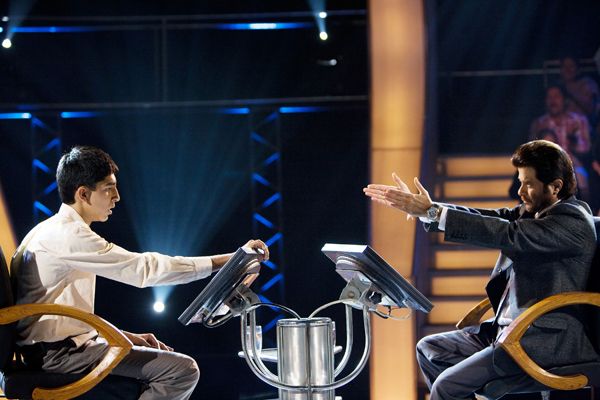
Slumdog Millionaire tells a relatively straightforward story which easily could have made for a hammy and shallow movie, but instead was made into one of the best movies of the year by director Danny Boyle (who made Millions, a movie very nearly as good). Our protagonist and hero in this story is Jamal, a young man who grew up in dire poverty in a Muslim enclave in India. We first meet him being introduced on the Indian version of "Who Wants to be a Millionaire," and then getting beaten up in a prison cell after being accused of cheating, having gotten all but the final question correct before time ran out on the first day of filming.

After this introduction, we jump back and forth between the present and the past, as Jamal explains how he came to know the answer to each question he'd been asked, with each explanation coming in the form of a little vignette from some point in his childhood. Jamal's first question is about a famous Indian movie star, and we go back to when Jamal was very young to see him go to great lengths to get the autograph of said movie star in a scene that first and foremost is supposed to be funny (and is). Afterwards though, we see his brother, Salim, take the autograph and sell it. Salim is less of a romantic and sentimentalist than Jamal, more resourceful, and more desperate to end their plight of poverty and start making money. This scene is the first hint of what will eventually become a large schism between the two brothers that will come to a head in the movie's last act. Another questions asks Jamal what object a certain Indian religious figure is usually holding in depictions of her, an image which, it so happens, was burned into Jamal's mind when his neighborhood was attacked by a band of Hindis who don't take too kindly to Muslims. He's orphened as mother is killed in the ensuing violence, and Jamal, his brother Salim, and another girl, Lakita, barely escape together.

Some scenes are more lighthearted, as when Jamal and Salim stumble upon the Taj Mahall--a building which has no real significance to them, despite its ability to attract tourists from most everywhere around the world--and do odd-jobs for naive tourists, like taking group photos for them, or giving them tours with completely fabricated information (like how the princess who inhabited the palace died in a traffic accident). Other scenes are much darker, as when Jamal, Salim, and Lakita, are taken in by a man who appears charitable but is actually using a veritable army of children for a truly despicable money making scheme. Eventually, Jamal manages to find a steady job at one of those huge call centers where Indian people pretend like they're from Oklahoma. He doesn't actually work the phones, though, he's an "assistant," which is a nice way of saying that he's basically an errand boy. Among his duties is serving tea to people, a fact which the sharply-dressed host of the "Millionaire" show--who vaguely looks like an Indian version of Dennis Miller--finds especially amusing.

All of these scenes reflect the stark differences in life between social classes in India. In a weird way, the fact that they used the Indian version of "Who Wants to be a Millionaire?" complements this theme of social stratification. The Indian version of "Millionaire" is just like the U.S. one, it takes place on a ridiculous set that looks like it could double as the interior of a spaceship from a bad 1950s sci-fi movie, adorned with stage lights that move around the stage in between questions for no other reason than to produce a cool effect. Watching the movie bounce back and forth between Jamal's life in the slums, and his "Millionaire" taping gives the "Millionaire" set a fantasy-like quality, as if Jamal is entering a different world, not just because he can win an amount of money that he couldn't even imagine earlier in his life, but because his life has never had the kind of frivolity enjoyed by the middle and upper class in India who can actually sit down and watch television. Consider his brother Salim at the end of the film, who chooses to rise up out of poverty using a much more direct route. He ends up wealthier than he was before, but essentially indentured to a local gangster.

Slumdog Millionaire is an uplifting story and in many ways a heartwarming story, but also doesn't have its head constantly up in the clouds. Its an excellent portrayal of the stark reality of the most impoverished places in India, but even without the social commentary works as an entertaining drama in the same vein as Quiz Show. Its been widely acclaimed and looks like it might sneak in with an Oscar nomination, an honor it would be most deserving of.

Wednesday, December 17, 2008

Red Dragon

Red Dragon (***1/2)

Like most who have seen it, I consider Silence of the Lambs to be one of the great all-time thrillers, and Hannibal Lecter to be one of the best all-time characters. I've never seen Ridley Scott's follow up, Hannibal, from start to finish in one sitting but, from what I've seen, I agree with what seems to be the general consensus, that it was too over-the-top and overt in comparison to its predecssor. When Hannibal is confined to a prison cell, the eloquent and supremely intelligent side of his character--the side that makes him an interesting character--is brought to the forefront. When Hannibal is allowed to roam free and is doing stuff like cooking Ray Liotta's brains while he's still sitting there with his skull split open... not as much. In this sense then, Red Dragon is a much more worthy descendant of the original Silence of the Lambs movie (although, its actually a prequel, was in fact Thomas Harris's first Lecter novel, and was adapted into a movie once in the '80s in the form of Manhunter) than Hannibal. I just picked it up off of Amazon.com, which had it for like five bucks as part of their Black Friday sale, and decided to watch it again. Seeing it for the first time in a while, there were some imperfections of it that bothered me moreso than I remember them bothering me initially, and I don't think its quite as close to being in the same realm as Silence of the Lambs as I may have thought at first. Nevertheless, its still a movie that's immensely entertaining with some excellent performances.

Chief among the reasons why the movie works is Edward Norton's performance as William Graham, a former FBI agent who went into early retirement after being the first to catch Hannibal Lecter and getting stabbed in the process. Norton speaks in the same sort of somber tone with the same emotionally drained looking expression that he had in Fight Club, juxtaposing the spasticness of Tyler Durden. Obviously, having come face-to-face with Lecter (and without plexiglass between them), Graham is less over his head and more in control than was Clariece Starling in Lambs, but Norton still plays him as sort of world-weary and forlorn as he witnesses the grizzly fate of the victims of the murderer he's persuing. The humanity in his character rings true, and the fact that he's easy to identify with and emphasize with is chief amongst the reasons why the movie is captivating.

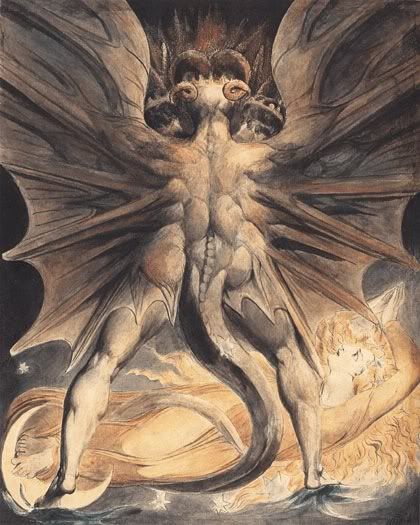
The aforementioned killer that is to Red Dragon what Buffalo Bill was to Silence of the Lambs (though he never instructs anyone to put the lotion in the basket) is the "Tooth Fairy" played convincingly by Ralph Finnes. Like Buffalo Bill, he seems aloof, socially awkward, and terribly uncomfortable in his own body. Also like Buffalo Bill, he seems obsessed with the idea of transformation, although in his case, instead of being a transvestite, he says he's going to become "the dragon." Its never really made clear what this means (of course, being very much insane, it may not be clear what this really means to the Tooth Fairy himself), but we learn that he's obsessed with the painting of the great red dragon (which I think is actually supposed to be Satan) you see at the top of this post, and he leaves the Chinese character for dragon outside of the houses of his victims. Unlike Buffalo Bill, we actually learn bits and pieces about his past which, combined with Ralph Finnes's intense, manic-depressive performance makes his character much more pitiful, and would probably be more memorable than Buffalo Bill were it not for Bill's oft-quoted "lotion in the basket" lines. Some of the movie's best scenes detail the agony of the character as he tries to develop an actual, meaningful relationship with a sweet blind girl (Emily Watson), despite the fact that the dragon is telling him to "give her to him."

All of this is well and good, but as I mentioned the movie didn't quite resonate with me quite as profoundly as I thought it did before. There are some scenes with Hannibal Lecter that are every bit as good as the best scenes in Lambs, but there are other scenes that seem too forced, with too much of a nudge-nudge, wink-wink effect in how they reference the other Lecter films. There's a scene where Lecter's cell is being cleaned out, where we see him strapped in a straight-jacket and in his famous mussle/mask thing (what the hell do you even call it?), but it has none of the potency of the scene in Lambs where he's wheeled into a courthouse and manages to berate a judge enough to get her to demand that the guards "get this thing out of my sight!" Instead, it seems to say, "Hey, remember that other movie with this guy?! That was good, right?"

The police investigation conducted by Graham and his mentor figure of sorts who brings him out of early retirement and onto the case (played well by Harvey Keitel) is interesting to follow but doesn't really reach the climax that it seems it should. Frankly, the FBI agents don't end up accomplishing much. I'm not saying that a murder mystery in a movie always has to end like a Scooby-Doo episode where they de-mask the bad guy and all of a sudden everything tied up in a neat little package. Really, I prefer that that isn't the case. But, the agents almost seem too inept here. Their characters are clearly supposed to be good at what they do, and we don't really have a hard time accepting that (certainly not in the case of Graham because we seem him catch Hannibal f'n Lecter in the first 5 minutes), but nevertheless nothing seems to go right for them. They discover a note from Lecter to the Tooth Fairy written in code and meant for the personal ads that they decide to let run in the paper which, as it turns out, when decoded contains Graham's home address. They decide to feed a story to an annoying tabloid journalist (Phillip Seymour-Hoffman) which backfires when the Tooth Fairy abducts said journalist, forces him to watch footage of his previous murders, and sends him down the street in a wheelchair on fire. As the movie reaches its climax, they discover everything about how he chooses his victims and how he operates. They race off to save Emily Watson's character, but by the time they get there, he's already decided not to kill her, burnt the house down, and she's manged to escape by herself. There's an epilogue which is a much more direct confruntation between hero and villain, but its not as satisfying as I think it could have been.

Still, the case is fascinating to follow, even if the FBI doesn't seem particularly good at solving it, Anthony Hopkins is as good as you would expect him to be as Lecter, and Ralph Finnes does an admirable job creating a frigening yet pitiful man who doesn't want to kill but can't help but kill on account of "the dragon." A good thriller.

Sunday, November 30, 2008

Tropic Thunder

Tropic Thunder (***)

Ben Stiller can be very funny, but more often than not recently he's been forced into a lot of asinine crap like Along Came Polly and Night at the Museum (see the Family Guy joke: "So, by this point in the movie we know that Ben Stiller's character doesn't like spicy food. Well, guess what's for dinner!!" "NO. WAY."). As such, Tropic Thunder, a movie that Stiller directed and co-wrote himself, is pretty refreshing to see. It's a tremendously funny movie that has a ton of star power in it, yet doesn't feel derivative and "Hollywooded-up" like the aforementioned movies Stiller has been in as of late.

The movie introduces us to its four main characters through fake commercials and trailers before the movie proper begins. We're first reminded that rapper-turned-actor Alpa Chino's new beverage,"Booty Sweat," is available at the concession stand in the lobby. We then see the preview for Tugg Speedman's (Ben Siller) new movie "Scorched VI," the latest installment of Speedman's action movie franchise in which he has to continuously prevent the apocalypse, which, nearest we can tell, he does by standing stoically on the edge of a canyon holding an assault rifle. "Scorched VI," we learn, will be completely different than the other five "Scorched" movies, because this time Speedman has to prevent the world from going into a deep freeze instead of being destroyed in a hellish inferno. Next, we see the latest vehicle for Jeff Portnoy (Jack Black), called "The Fatties," in which Portnoy plays every role. It consists mostly of fart jokes and is eerily similar, and no doubt intentionally so, to the very much real Nutty Professor movies. Lastly, we're introduced to the Australian-born Kirk Lazarus (Robert Downey Jr.), who is heavily into method acting and who tends to gravitate more towards art-house, Oscar-bait roles, as we see from his role in "Satan's Alley," which is basically Brokeback Mountain except in an abbey.

This segues into "main" part of Tropic Thunder begins, where we see that all of the above actors have been cast in a movie-within-a-movie of the same name. It's a big-budget Vietnam war film, with all the explosions, random wanton violence, and action movie cliches of a movie like Rambo, in spite of the fact that its supposed to be adapted from a (purportedly) true story written as a book by an actual Vietnam veteran. They're joined by Kevin Sandusky, a dorky looking kid who looks like Joker from Full Metal Jacket when he's in costume and talks mostly about stuff like the merits of Blu-Ray vs. HD-DVD when not in character. We learn that the movie is already behind schedule a week into filming, at that there are questions as to how well the movie's young, upstart director, Damian Cockburn, can keep the massive undertaking under control. After a massive pyrotechnics scene goes awry, Damian seems at the end of his rope, which is when Four Leaf Tayback (Nick Nolte), the veteran who's on the set to see how his story is being brought to the big screen, suggests that he take the actors out in the wilderness to really "get 'em in the shit!" Damian then concocts a plan to film the movie in an avant-garde style by actually having the actors trek through the Vietnamese jungle, while they're filmed on hidden cameras mounted amongst the trees. For reasons that I won't spoil, the plan goes horribly awry very early on, leaving the actors to debate whether or not they're still being filmed and trying out figure out where the hell they're going.

The entire movie is pretty funny, but Robert Downey Jr. completely stands out head and shoulders above everybody else. His character, despite being Australian, is cast as an African-American Sargent, and he undergoes a controversial "pigmentation procedure" to better recreate his likeness. This doesn't sit well with Alpa Chino, who points out that, "They gave the only good role for a black man in this movie to Crocodile Dundee!" Kirk Lazarus tries to plead his case with him, but mostly makes things worse as he refuses to break character (not before doing the DVD commentary, he says) the entire time and constantly talks like an overexaggerated Ving Raymes. Robert Downey is nearly unrecognizable in whatever make up they put him in to look black (I'm gonna go out on a limb and say that it wasn't actually a pigmintation procedure in real life), and holds nothing back in creating a character that's completely over the top in the best way.

Ben Stiller's character is funny as well. I think he channels a little bit of Zoolander as he moves haplessly through the jungle, at one point making a disguise out of a panda skin. Jack Black's character spends most of the movie going through withdrawl after he loses his stash of heroin early on in the filming. He has a couple of very funny scenes as he attempts, mostly unsuccessfully, to keep himself from freaking out, although his character's not quite as consistently hilarious as Robert Downey's. Back in Hollywood, there's a subplot with Matthew McConaughey as Tugg Speedman's agent, which isn't quite as funny, until he shows up in the big climax, and I think detracts from the main plot in the jungle more than complements it. There is another very funny appearance by a well known actor which I won't spoil, because for once the commercials actually did a good job of keeping it under wraps. I'll just say that its probably the next funniest thing behind Robert Downey Jr's performance. As I've described, some bits work more than others, but as a whole its a very enjoyable movie.


I remember there being a big controversy when the movie came out regarding its use of the word "retard." Having seen it now, I can tell you what I pretty much suspected to begin with, in that the controversy is mostly complete nonsense. There's a bunch of references in the movie to a character Tugg Speedman played earlier in his career called "Simple Jack," which was meant to be a character that would be endearing to audiences in the way Forrest Gump was, but which failed miserably. Kirk Lazarus's theory is that Speedman's problem was that he went "full retard," point out, for example, that Rain Man wasn't "full retard" but just autistic. There's a whole conversation where they speak about playing "retards" in cruel terms like this, but that's the whole point really. All they really care about is whether or not depicting these characters will get them critical acclaim. They don't actually care about shedding light on the hardships of actually being mentally challenged or anything of the sort. That the two are so nakedly insensitive is the whole reason why the scene is funny. If I may say so, this was a retarded controversy.

Thursday, November 20, 2008

Quantum of Solace


Quantum of Solace (***)


Two years ago, I saw Casino Royale and loved it, as did most critics. After the Pierce Brosnan films descended into a downward spiral of silliness-- culminating in stuff like Bond outrunning a laser from space across an ice shelf in his Aston Martin in Die Another Day--the stark, gritty realism of Casino Royale was a welcome breath of fresh air. Furthermore, Daniel Craig seemed to bring a new depth to the character that hadn't existed in a long time. I was therefore somewhat surprised to see the very mixed reaction to Quantum of Solace, despite the movie once again starring Craig and, by all appearances in the trailers, having much the same tone and style as its immediate predecessor. Having now seen the movie, I'll agree that the movie probably represents a half-step backwards from what Casino Royale, and that there's room for some negativity towards it, though not quite the level of negativity coming from some critics.

Quantum's most jarring change from the standard Bond formula is that its a direct continuation of the story from Casino Royale. Other Bonds have had recurring villains, like Blofeld, and his criminal organization S.P.E.C.T.R.E., but even still, they're essentially self-contained stories. Conversely, anyone who hasn't seen Casino wouldn't really have the full picture of what's going on in Quantum. After Casino ended with Bond tracking down the mysterious "Mr. White," the man Vesper contacted when she betrayed Bond and MI-6, Quantum opens with Bond racing his way to meet with M (as played by Judi Dench for... I guess this is the sixth time?), with Mr. White in his trunk. Bond is still pissed off that Vesper was killed, he still has a problem with killing people that really need to be questioned first, he's still seen as the rogue agent of MI-6, and the plot still finds Bond trying to infiltrate the same organization, though we discover its now much now much larger in scale and it has a name, Quantum, hence the title. That so many of the themes from the last installment are continued here is perhaps the movie's biggest downfall, even though they're themes that worked well in Casino Royale. It feels a little bit stuck in the mud, not willing to push this latest iteration of Bond much further than what the last movie showed us. The movie does give us a new villain from elsewhere within Quantum with a devious plan of his own to try and spark some new interest and give the movie at least some sense of being self-contained, but the villain is only mildly interesting and mostly forgettable.

The aforementioned villain is Dominic Green, the CEO of an energy company looking to install a new, business-friendly regime in Bolivia. The Americans in the CIA get the gist of what's going on, but don't care to intervene, except for Bond movie staple Felix Lighter, whose crisis of conscience about the whole thing gives him a role to play in the movie. The whole scheme leads to some decent pot-shots at U.S. foreign policy and big corporations who claim to be big on the environment but are actually pretty ruthless in destroying it. The villain himself, however, is rather uninteresting. He has the same sort of smartest-guy-in-the-room, "hey everybody, look at how ingenious of a business man I am" thing going on that Le Chiffre did in Casino Royale, but doesn't have much of a personality, and is only mildly threatening, really. He certainly doesn't have any interaction with Bond or with any other character long enough for him to have any truly endearing moments on the level of say, an Auric Goldfinger ("Do you expect me to talk?" "Oh no, Mr. Bond, I expect you to die!").

The action sequences are great, but there's not really enough going on in between them at times. Casino Royale was described by many as sort of the "Jason Bourne-ification" of Bond. I think this one has even more in common with the Bourne movies, but isn't quite as well executed. Part of what kept Casino Royale so interesting was Bond's very humanizing relationship with Vesper. In Quantum, Bond's lust for revenge and detached nature after Vesper's death was already reflected somewhat in Bond's conversation with M at the end of Casino, and wasn't really enough to play out over an entire second movie. In Quantum, the biggest female role is that of a woman whose family was killed when she was a little girl by the dude who's about to be reinstalled as President of Bolivia and is basically out to get even. The filmmakers try and create a whole juxtaposition between her and Bond as they both try and cope with a painful loss and a desire for vengeance, but it ends up feeling pretty shallow and buddy-cop-ish.

The continued move away from the cheesiness and cliches of the most forgettable of the Bond movies is much appreciated, but I want these movies to start incorporating at least some of the classic Bond wit, which right now we're only treated to brief moments of. This movie, while enjoyable to watch, felt far too nihilistic for a Bond movie. I'm not saying I want to see Q following Bond around at every moment in a goofy-ass fake beard dispensing exploding staplers or something, but I think the movie needs to gravitate a bit more back towards Bond as being the embodiment of cool, instead of a tortured soul.

The iconic gun barrel, "oh crap, Bond just shot me in the face," opening that once upon a time began each movie--but appeared only in a somewhat revised form in Casino Royale after its grainy black-and-white opening--appears at the end of Quantum of Solace. It's possible that this is sort of the symbol of the "prequel" story formed by Casino and Quantum coming to an end, and that the next movie will be more of a traditional Bond movie. In other words, that it signifies that this Bond has made the complete transformation into what we all know as 007. Or maybe I'm just reading way too much into it, I dunno.

Typealyzer

I stumbled upon this "Typealyzer" thing, which claims to be able to determine what type of person someone is based on the writing on their blog. This is what it gave me:

ISTP - The Mechanics

The independent and problem-solving type. They are especially attuned to the demands of the moment are masters of responding to challenges that arise spontaneously. They generelly prefer to think things out for themselves and often avoid inter-personal conflicts.

The Mechanics enjoy working together with other independent and highly skilled people and often like seek fun and action both in their work and personal life. They enjoy adventure and risk such as in driving race cars or working as policemen and firefighters.


The site makes sure to point out that its still in Beta. Either it knows me better than I know myself, or they need to tweak this thing some before they take Beta tag off of it. I don't really anticipate starting an exciting new career in firefighting any time soon.

Friday, November 07, 2008

Futurama: Bender's Game


Futurama: Bender's Game (***)

Bender's Game is the third of the straight-to-DVD Futurama movies, and I'd say its in the middle of the three in terms of how much I enjoyed it. It certainly goes pound-for-pound with Bender's Big Score and The Beast with a Billion Backs in terms of its laugh-out-loud moments, but it seems to lack some of the heart that I've come to expect from Futurama. It feels a little bit more like a Family Guy episode in that there's a lot more tangential little bits here and there that are really good for a punch line or two but don't really further the story along. Furthermore, we don't get any real development between characters, like Fry and Leela, which is disappointing after it how well it was done in both the series finale of the show and then again in Bender's Big Score.

There is a lot of undeniably funny stuff packed into less than an hour and a half's worth of movie and there are a lot of individual bits that hold up to the best bits from any point of the series. For the most part, though, they're confined to the first half. Mom is back, along with her Three Stooges-esque sons (at one point they basically break the forth wall and point out that they're basically like the Three Stooges, with Leela and Amy pointing out that they're not as funny to them as, say, Sex and the City). Another personal favorite of mine, the surly trucker guy ("We're all scared, its the human condition. Why do yous think I put on this tough-guy facade!") has an excellent cameo. The second half descends into a Lord of the Rings/Dungeons & Dragons parody, which at times feels like its straining for laughs and seems like its something out of something like Epic Movie. At one point, Fry essentially turns in to Gollum from obsessing over a 12-sided die with mythical powers which he calls something like the "doeca-delicious," and looks into a reflection to see the evil half of himself trying to sell him a knife in the style of a late-night home shopping show. It kind of made me laugh, but at the same time felt pretty hammy and very un-Futurama.

Thus far, the Futurama DVD movies have certainly been worthy successors to the TV series, and haven't felt as though they've jumped the shark at all, but haven't felt as though they're the best-of-the-best. Hopefully, they're saving the best for last (or at least what's planned to be the last), but if the fourth is on the same level as they've been so far, I won't really feel slighted.

Sunday, November 02, 2008

RocknRolla

RocknRolla (***)

Nine and eight years respectively since Guy Ritchie put himself on the map as a director with his British crime flicks Lock, Stock, and Two Smoking Barrels, and Snatch, Ritchie tries to again make himself known as something other than the dude that was married to Madonna with his latest offering, RocknRolla. The movie is a lot like its spiritual predecessor Snatch in that it continuously jumps back and forth between different characters in different parts of the London crime world, whose stories eventually converge as the movie reaches its climax. In Snatch, the movie dealt with an unlicensed bare-knuckle boxing ring, certain elements of which eventually converged with a diamond heist gone wrong. In RocknRolla, the crime that is the centerpiece of the movie is a little more white collar, dealing with back-channel real estate deals, but as the story develops it eventually begins to involve all manner of degenerates, from junkies who sell stolen clothes, to sports bookies, to sadistic Russian mobsters.

Early on in the movie we meet Lenny Cole, played by the always excellent Tom Wilkinson, who doesn't fancy himself a gangster, but is quick to point out proudly that he "owns London". Despite being an angry old bastard who's suspicious of "the immigrants" he finds himself making a deal with a Russian businessman who wants to build a huge arena but doesn't have the permits for it. He even lets Lenny borrow his lucky painting to solidify their partnership. The shit hits the fan, however, when the painting is stolen from Lenny's office and Lenny quickly deploys his right-hand man, Archie, to scour the area for whoever stole it. Archie is in some ways reminiscent unnamed main character of Layer Cake, which I coincidentally just watched pretty recently. He seems devoted to his job, but also seems sort of detached and a bit weary of it. Beyond that we never really learn much about him until we get a big revelation about Lenny at the end that affects Archie quite personally.

Elsewhere, we meet a trio of guys named One-Two, Mumbles, and Handsome Bob (probably not their birth names, gonna go out on a limb there), who are still low on the London crime totem-pole, and so to get money they accept "a bit of work" whenever they can get it. For one job in particular, One-Two--played by Gerald Butler, who doesn't yell constantly like he did in 300, but often times still has that same goofy grin on his face as when he played Leonidas--meets up with Stella, who wants them to secure a bit of money, of which they'd get a cut. Stella (played by Thandie Newton, who I barely recognized in this role, but played Condi Rice in W and the woman who gets felt up by Matt Dillon in Crash) is an icy-cold vixen sort of character, and has a sort of alluring aura of mystery about her. She's one of the more interesting characters in the movie. At it turns out, Stella is working for the Russians as an accountant (the kind that can be "creative" with numbers), and the money they're stealing is the Russians' money. This leads to all kinds of finger pointing, and then all manner of violence between Lenny's group and the Russians.

At the same time all of this is going on, Johnny Quid--rock star and estranged step-son of Lenny--has sequestered himself on a drug binge after faking his own death. When its revealed that his presence will be necessary to make everyone involved in the real-estate deal not want to kill each other, his two record producers, played by Ludcaris and Jeremy Piven, have to go looking for him. Their characters aren't without their charms, but their sections of the film are probably the least interesting.

Even though everything comes together at the end of RocknRolla in much the same way that everything comes together at the last boxing match at the end of Snatch, the whole product wasn't quite as satisfying to me. There are certainly a lot of similar examples of sharp writing and ingenious one-off bits--like when One-Two goes out of his way to taunt a slightly pudgy Russian mobster as he outruns him down a set of train tracks--that make you realize why you like this sort of genre in the first place. At the same time, however, Lenny's character, while well-devised and well-played by Tom Wilkinson, doesn't project the same sort of evil and dread that the boxing promoter did in Snatch (I'll never forget the scene where he helps himself to some of Jason Statham's coffee and announces chillingly: "No sugar for me. I'm sweet enough!"), and the quick jump cuts between characters seem somewhat more muddled and don't give you quite the same sense of the plot headed towards an explosive climax. At any rate, if you're a fan of Guy Ritchie's previous stuff, or British crime dramas in general, you'll certainly enjoy this movie. Until next time, keep being a real rocknrolla.

Monday, October 27, 2008

Tim McCarver \ World Series Weirdness

Is there any conceivable reason for Tim McCarver being allowed to announce baseball, let alone have announced the World Series for... I don't even know how long? It's just brutal listening to him. I'm not a huge fan of Joe Buck either, but Buck is at least tolerable. I don't really like his announcing style, but he's certainly a very playable play-by-play man. The problem is when McCarver tries to interject something playing off of what Buck had just said and it comes out not making any sense whatsoever.

The thing is, McCarver is one of serveral announcers covering major televised sports whose continued employment is simply confounding to me. Before he finally retired, (a couple of years after he said he was going to retire initially) Fox would trot out Pat Summerall, who for all I knew was asleep during half of the games. There would be times going into or coming out of a commercial break in which you would expect the play-by-play guy to give a summary of the current situtation in the game, where Summerall would just sort of meekly say "The Bears.... lead......" and sort of trail off while you just sat watching a shot of the field in complete silence before the producer finally figured out, "Oh shit, he's not gonna say anything else." Hawk Harrelson does this a lot announcing White Sox games, but he does it because he's pissed that the White Sox are losing. Summerall just seemed completely disinterested in anything going on around him. Aliens could attack the stadium and Sumerall would just sort of say, "Well... we've got some... aliens."

Dick Stockton, who just announced the Cubs/Dodgers NLDS (making it that much more painful for me) sounds equally disinterested in what he's doing except he talks more. So instead of 3-hours of mostly silence you sort of get 3 hours of a long stream of monotone like HAL-9000 or something. The thing uniquely bad about Dick Stockton is that he can't seem to be bothered to learn how to pronounce anyone's names. In 2007 in the Cubs\Diamondbacks NLDS he consistently pronounced Mike Quade's name "Kwade", rather than "Kwah-dee." This year, every time he tried to pronounce Kosuke Fukudome it was a struggle. I've seen clips of old NBA Finals games with Dick Stockton announcing, and while I still don't really like him as an announcer in any era, back in the day he wasn't nearly as monotonus and sleepy sounding as he is now. How do these old crumugeons keep getting work in the biggest of sporting events? Is it just loyalty for the seniormost guys? TV executives are always thought of as being obsessed with ratings to an extraordinary degree. I've never once heard anyone say, either online or face-to-face, "You know who I love is that Tim McCarver!"

*******************************

Speaking of the World Series, Game 5 was just suspended in a 2-2 tie in a brutal cold rain in Philadelphia. After it was delayed in the bottom of the 6th, with the Rays having tied the game in the top half of the inning, Chris Meyers interviewed the Chief of Operations (I think that was his title) and he said that the tying run being scored had nothing to do wtih the decision. Yeah, I'm gonna call bullshit on that. He described conditions as having "deteriorated," but they were pretty brutal when the game was still 2-1. There was noticable water pooling on the corners of the infield. Had the game been delayed at 2-1 and not restarted, the game would've ended since 5+ innings had been played, and the Phillies would've won the World Series. From what I've heard, ratings have already been bad for these playoffs. Baseball isn't going to end the season on a rain delay. I wouldn't be surprised if the rules for calling World Series games were changed in the offseason. Its not like they have other games to schedule around. I guess there's TV to consider, but FOX is going to televise the conclusion of Game 5 tomorrow despite the fact that they were supposed to have new episodes of stuff on. At any rate, with Game 3 having ended at about 12:45 Central because of a rain delay and now this, this has been a pretty messed up World Series.