Saturday, July 04, 2009

Public Enemies


Public Enemies (***1/2)

A few years removed from his modern day crime dramas Collateral and Miami Vice, Michael Mann decides to take a stab at a prohibition-era gangster movie with Public Enemies, bringing along a powerful tandem of lead actors in the form of Johnny Depp and Christian Bale. The film looks a little bit more like a traditional movie than Collateral--which was shot mostly on hand-held digital cameras at night on location in LA, without a lot of the usual preparation that goes into shots using traditional film, like setting up lighting. Nevertheless, there are some shots that aren't entirely dissimilar from the style that Mann established in Collateral, with a lot of close-up, shaky, hand-held camera shots that frantically track characters, and an overall sense of being directly in the middle of what's taking place.

Johnny Depp is our protagonist playing John Dillinger, the most notorious amongst a loose alliance of bank robbers that included other legends of crime like George "Baby Face" Nelson. He seems to fancy himself in some ways as a Robin Hood type of figure. We see him cleaning out a bank vault, but then on the way out making a point to hand back the money customers and tellers have nervously pulled out of their pockets in anticipation of him demanding it. He's not against "the people", just the banks. At the same time though, he doesn't seem to see what he does as some sort of crusade against the evils of social stratification, but rather just sort of what he does to "live in the moment." Confronted with the reality that there's a nationwide manhunt for him which will certainly eventually catch up to him, Dillinger simply says "We're having too much fun today to be thinking about tomorrow." At a party, he becomes infatuated with a woman named Billie Frechette, and when he meets her again as she's working at a coat check, he roughs up a guy impatiently waiting for his coat, and tells her to leave with him because "You're with me now," and people who are with John Dillinger don't work at coat checks. As free-wheeling as he is, though, he's also not a psychopath, which puts him at odds with his frequent cohort Baby Face Nelson, who during one bank robbery starts firing randomly at onlookers as they're making their way to their getaway car.

After we're sufficiently introduced to Dillinger and his gang, we're introduced to their counterparts on the other side of the law. Christian Bale is Melvin Pervis, a federal agent who we first meet in the woods as he pursues--and eventually calmly guns down with a rifle--"Pretty Boy" Floyd, another notorious fugitive. Pervis becomes the poster boy for J. Edgar Hoover, who you might know from history either as the dude who created the FBI, or the dude who liked to cross-dress a lot. Evidently, here in 1933, Congress isn't quite sold on the whole idea of the FBI as a crime fighting organization, chastises Hoover during a hearing, and refuses to increase his funding. Hoover, nevertheless, uses what resources he has to set up a massive manhunt for Dillinger & co. with Pervis as point man. Christian Bale always has a tremendous, commanding presence about him which goes a long way, but even still, his character isn't really all that interesting here, especially compared to what the movie does with Dillinger. Other than one scene towards the movie's conclusion where he makes a decision regarding the morality of the FBI's tactics, basically the whole of Bale's character is that he's a guy who really, really wants to catch John Dillinger.

Watching the FBI investigation itself unfold though is a lot of fun though. I'm banking under the assumption that the movie and the book upon which its based did their homework, and that the equipment and tactics used are fairly accurate to what was used in reality. A lot of it seems to basically mirror the tactics that are used today, only utilizing cruder, older technology. The resulting effect makes it look like a weird steampunk version of Enemy of the State or something. The FBI puts a wiretap on the phone's of Dillinger and his girlfriend, but since its 1933 all the conversations are recorded onto phonographs. All of it is done in a room which is completely dark, except for the lights on the massive banks of phone line connections, making it look kind of like the room that controls the superlaser on the Death Star.

There are some great looking exterior shots as well, as set pieces of old Chicago are woven seamlessly into Michael Mann's frantic, always in motion shots. One that particularly stands out in my memory is a drive-by shot of the Art Institute. The atmosphere for the entire film is great. I'm convinced that the tommy gun is the ultimate crime movie weapon. They're obnoixiously big and loud and its hard not to look like you're completely bad news while you're carrying one. There's a scene where the FBI tracks down Dillinger and Nelson to a backwoods safehouse in Wisconsin which leads to a middle of the night gunfight which at times is lit pretty much entirely by the flashes created by the machine gun fine being exchanged. It contains no music and absolutely none is necessary for it to be thrilling.

Some might find the actual plot of Public Enemies to be a little bit simplistic and predictable, and indeed I don't think anyone will walk out of the theatre saying "Wow, I didn't see that coming" in regards to the ending or any other point of the movie. And while I imagine that the movie gets the broad strokes of the real-life story of John Dillinger correct, there are times when it seems embellished to the point of it threatening your suspension of disbelief, as when Dillinger just sort of moseys into the crime unit that's in charge of investigating him, and no one seems to notice who he is, even as he asks what the score of the Cubs game is. Nevertheless, Michael Mann manages to put a tremendous amount of energy into scenes like the nighttime gun fight described above, and there's more than enough inherent drama in the escalating duel between the FBI in its birth pangs and the most wanted bank robbers at the end of what the film's opening title card calls the "golden age of bank robbery" to draw you in and keep you drawn in.


Saturday, June 27, 2009

RedRum Beer


In the debut installment of my ultra-novice beer blogging, we looked at an India Pale Ale. This time around, we're going to look at two different varieties of red beers.

The style guideline for Irish Red Ale (thanks to my friend for linking me to it) says that it should be easy drinking with "an initial sweetness and a roasted dryness in the finish." The reddish color is achieved by roasted barley. Irish red ales are "malt-focused", and usually don't have a noticeable aroma of hops, although several recipes I've found have called for the addition of Kent Goldings hops. A brief Googling turned up this site with three distinct Irish red recipes, and indeed all of them call for roasted barely. The other components seem to vary somewhat. One of them calls for adding honey, another adds chocolate.

2. Killian's Irish Red

Image source (via Google Images)

Killian's Irish Red, named for George Killian Lett, who founded the brewery that crated the originally recipe in Ireland in 1864. It was originally an Irish Red Ale, but is now brewed in America by Coors and is now considered an American style amber lager. The transition was done to give it a broader appeal, and making it a lager took out some of the fullness of it, and reading around on stuff like beer-advocate.com it seems as though people who are big beer aficionados have quite a disliking for it for that reason. This is apparently not unprecedented, though, as makes a note that beers classified as such can be brewed as lagers. Personally, I've always really liked drinking Killian's. I don't doubt that there are better red ales out there which are truer to the whole tradition of the style, but I certainly think Killian's is a good beer and its readily available. I know there's several bars I've been to that have had it available on tap, and if you want to buy a 6 pack of it you can buy it pretty much anywhere.

3. Berghoff Famous Red Ale

This was on tap at an Irish pub in Downer's Grove which I decided to try on a whim. I ended up liking it enough such that I ordered it again the week after when I was there again. The name comes from the historic Berghoff restaurant in Chicago which is now closed, but there's still a line of beers being produced with the Berghoff name, now brewed in Wisconsin. According to Rate Beer's entry for it, its brewed with "Brewer's Two-Row Malt, Caramel 40 Malt, Carapils Malt and domestic hops" and its classified as an American Pale Ale. Two-Row Malt is used as a base for American style beers, Caramel malt--so named for its crystallized sugar--gives (appropriately enough) a caramel flavor and adds to the redness of the color, and carapils are used in pale ales to "balance body and flavor" without adding color. Reviewers on Rate Beer seemed to largely hate this, one review describing it as tasting "metallic." I think it does have a bit of a harshness to it, but I think metallic is a bit of a strong word. It certainly wasn't harsh enough to not make me want to drink it twice.

I've had a number of other red ales in addition to these. I think I've had enough of them to say that really like it as a style, seeing as I really like what are considered some of the "bad" entries of the style by those who study this stuff closely. Perhaps I'll post about more varieties down the road.


Sources: Wikipedia - Killian's, BJCP Style Guidelines, Real Beer.com, Rate Beer - Berghoff, and anything else I linked to above but maybe didn't put down here

Friday, June 19, 2009

The Confounding Collapse of the Cubs (alliteration is fun!)

It's been a long time since I blogged about the Cubs, partly because I've been busy with other stuff, and partly because doing so would just be too damn painful. The team that seemed pretty much poised to dominate a weak division again at the start of the year has been stuck in a malaise, with almost no offensive output to speak of. Currently, the team is a game under .500, sitting at 34-35, putting them tied for 3rd in the division, 3.5 out of 1st. No one else has really asserted themselves as a leader in the division--and really the entire NL has just been sort of a big blob except for the Dodgers, who are sitting pretty with a big lead in the NL West at 47-26--and so the Cubs certainly still have plenty of time to get themselves right and take over first, but that doesn't really make the baseball that's been on display in recent weeks any less frustrating to think about.

There's been no singular reason for the team's poor play, but first and foremost among any reasons you want to throw out has to be the injury to Aramis Ramirez. The Cubs haven't really been able to find a good replacement at all for him at 3rd base, not only to replace his offense but also his defense. Much of the playing time at 3rd has been given to Mike Fontenot, who hasn't been a complete wreck defensively, but certainly hasn't stood out as being excellent either. This would be fine if he were able to put out some decent numbers offensively, but as of my writing this, he's hitting .222 with a .670 OPS. Recently, some time at 3rd has been given to call-up Jake Fox, who has hit the ball well thus far, but who is even more of a liablilty defensively. Fox was absolutely tearing the cover off of the ball at AAA, but he's just now getting to the majors at 26 because he's never proven that can can play a good corner outfield at the major league level, let alone at the hot corner. The Cubs's struggles at 3rd base once again raises the spectre of the off season trading of Mark DeRosa for questionable pitching prospects. Last year was a career year for DeRosa and, as I've written before, the Cubs were probably using a mentality of "buy low-sell high", banking on the fact that DeRosa's 2008 numbers were probably a one time thing (although, judging by what he's done so far with Cleveland, maybe not). But even still, even a Mark DeRosa who produces anywhere close to his 2008 output would be a tremendous safety net for what has been the most severe injury for the Cubs this year (severe both in terms of its effect on the player physically, and its effect on the team).

The lack of a good 3rd baseman has been the least of the Cubs's problems, however, and while injuries are always a risk that has to be considered, some of the other issues with the Cubs have been hard to explain. Alfonso Soriano--who, for all his faults, is usually good to be penciled in for an average of at least .280 for so with a bunch of home runs--is currently hitting a meager .229. After hitting .284 in April, his average has gone way downhill from there, and is currenly a sub-Mendoza line .195 in June (as usual, I'm getting my stats from Baseball Reference). Milton Bradley, who has improved to an extent, and is at least managing to stay on the field for the most part, is nevertheless hitting just .238 on the year with anemic power numbers of 5 HRs and 16 RBIs. And last year's Rookie of the Year Geovany Soto, is hitting .231 with 6 HRs and 21 RBIs, and has garnered attention this year more for looking like he got kinda fat, and for having tested positive for pot during the World Baseball Classic than anything else this year. Add all of these disappointing performances up, and here's what you get statistically for the Cubs through 69 games. Compare that to what they did over the same period last year:

2008: .247 Avg., .324 OBP, .400 Slg., .724 OPS, 292 runs
2009: .283 Avg., .361 OBP, .442 Slg., .804 OPS, 380 runs

Its not even particularly close. Aramis Ramirez has been the team's best power hitter in recent years, and there's reason to believe that things will get better when he returns (that is if he can return this year in a healthy enough state to be effective), but clearly a lot more has to change than just Ramirez's absense.

The bullpen has still had issues as well, notably Carlos Marmol, who has still proved difficult to get hits off of, but who has seemingly lost all of his control, walking a staggering 35 guys in 34 innings pitched. What's kept the team from spiraling into a complete nose dive has been the starting pitching, which has been solid all year. Carlos Zambrano, Ted Lilly, and Ryan Dempster all have ERAs under 4.00, and Randy Wells, who pretty much came from out of nowhere, and who was originally meant as just a brief fill-in guy during Zambrano's DL stint, has an ERA under 3.00 in 8 starts. I think the Cubs' rotation is one of the best in the NL, but who knows if its going to hold up at this level, so it would certainly behoove the Cubs to get the problems elsewhere on the team sorted out sooner rather than later. An added wrinkle is the that the Tribune Company's sale of the team is going along at a sluggish pace, and current frontrunner to buy the team, Tom Rickkets is having trouble raising capital for it. As such, many have speculated that the Cubs might not have much wiggle room to add salary at the trade deadline. And so it becomes doubly important for the Cubs to try and work out their struggles from within.

Wednesday, June 17, 2009

New Feature... BEER!

I haven't blogged about the Cubs in a while. I'm going to try making a post in the near future, but I'm really not looking forward to it. Cubs baseball has been something of a trainwreck for a while now. In the meantime, let's metaphorically drown our sorrows by blogging about beer. I've thought about doing this for a while, because I like trying out new beers and I've been curious as to just how big a list it would be if I compiled all the beers I've sampled. At some point though, it occured to me that I basically don't know much of anything about beer. I know what I like, and what I don't like, but I don't really know anything about brewing, nor what exactly the different varieties of beer actually entrail, nor how beer is generally described by people who know what they're talking about. So I figure the best approach to this would be to basically try learning as I go, so that's what I'm going to do. As I find beers to write about, I'll try and scour the interwebs for what more seasoned drinkers have said about it, and find a little information about the style of beer and how its brewed. I'll add my own thoughts as best I can as we go along. But a lot of it isn't going to be my own thoughts whatsoever, so I'm going to try to remember linking to all the sources I'm getting this stuff from.

Let's start off with an India Pale Ale:

1. Lagunitas IPA

(Image source, via Google Images)

IPA, if you're not privvy to beer related acronyms, stands for India Pale Ale. Seeing as this is the first post on the subject, lets keep it simple from the outset and take this one step at a time. First things first,

What's an ale?

Ales are brewed with "top-fermenting" yeast, meaning that it rises to the top of whatever its being fermented in. Lagers, conversely, use "bottom-fermenting' yeast, which sinks to the bottom. Ales take less time to brew than lagers and tend to be sweeter. They're usually fermented in a range between 60 and 75 degrees fahrenheit.

Okay, so what the hell is a pale ale?

Getting the obvious part out of the way, pale ales are pale in color. Evidently, there's actually a scale for judging the color of a beer, with the very generic name "Standard Reference Method." Evidently, Pale Ales are usually 8 to 14 degrees SRM. They came into existence in the 18th century in England after brewers there began incorporating coke into the brewing process (presumably that's coke as in the byproduct of smelting, not cocaine). The usage of coke allowed a more controlled burn during the "kilning" process--drying wet grain by way of an oven--which allowed for the brewing of a paler colored beer. The darker colors of beers that were traditionally brewed at the time came as a result of the grain literally being scorced in the oven where it was kilning. Before this, it wasn't possible to brew beer with this sort of a color. About.com desribes the traditional British Pale Ale as having "a malty profile and just enough woody or lightly floral hops for balancing" Over time, other styles of pale ale have been producted elsewhere, in places such as the US, France, and Germany.

So lets put it all together now... what the hell is an India Pale Ale

India Pale Ale's are named such because they were often exported to India from London in the early days of Pale Ale brewing in London. As innovations made it possible for the beer to survive the trip there--such as the use of hops, which are natural preservatives--a large market opened up for them and the denizens of British-controlled India developed quite a taste for them. IPAs usually have a high alcohol content, from 5.5% to 7% in most modern versions, while sometimes over 8% in the old batches brewed in the 1700s. IPAs generally make use of carapil and crystal malts (see here for a description of these) and are described by the North American Brewer's Association's website as "possess[ing] a nose of perfumey alcohol, fruitiness, and malt, although newer versions frequently overshadow the malt with strong hops." The types of hops used vary from British and American styles. The American style calls for hops which project a citrus flavor, which I think I detected drinking the Lagunitas, although really what do I really know at this juncture. I've been drinking beer for a long time, but this is the first time I've thought about it nearly this much.

Getting that out of the way, lets see what people who presumably know way more than I do are saying about the Lagunitas IPA. Its sitting on a B+ overall rating on Beer Advocate and an 87 on Rate Beer. Reading individual reviews, they seem to be kind of all over the place, but if there's any consensus it seems to be that the beer has a pleasant earthy, "grassy", aroma to it, and that its very drinkable, alhtough perhaps not as flavorful as it could be. I suppose I can be confident enough in my beer-tasting palette to at least agree with the basic premise this. I'm not really one who likes to try and project some sort of aura of rugged masculinity by embibing in the strongest, heaviest beers possible. To use another term that I just learned, I'm prone to "sessinonable" beers, that are more about taste than hitting you heavy with a ton of alchohol. Lagunitas is 5.7% alchohol by volume, which is at the lower end of the range for IPAs, but IPAs are still high compared to most other pale ales. With Lagunitas, I didn't get much of a harshness from it. It was definitely a very drinkable, "sessionable' beer. I liked the taste of it, I don't know if I loved it. Its something that I would drink again and certainly wouldn't refuse if it was offered to me, but perhaps wouldn't go far out of my way to get my hands on it. I don't think I've tried enough IPAs yet to really determine if that's because I'mw just not hugely crazy about IPAs as a style, or because I didn't like Lagunita's particular take on it. Perhaps that will change in the future. We'll see.

For the next addition of this, I think I'm going to write about a beer that I've been drinking for some time now, and is probably more well known than Lagunitas: Killians Irish Red.

Sources:

Wikipedia (articles: Ale, Pale Ale, India Pale Ale, Standard Reference Method)
beer.about.com
North American Brewer's Association

Friday, June 05, 2009

Wall-E


Wall-E (****)

Despite how much many of them seem to be universally loved, for the most part I've avoided the big animated movies that have come out of Pixar and Dreamworks in recent years. I don't really know why. I certainly can't say that I consider them beneath me, being "kid's stuff", because I spent a significant portion of my Memorial Day watching the Teen Titans marathon on Boomerang. But all the praise for Wall-E, from every age group, was too difficult to ignore, and I finally got around to watching it a couple of weeks ago. It really is one of the best American animated movies I've ever seen, and certainly one of the smartest, and not in a "how many pop culture references can we find a way for the furry animal characters to say" sort of way. It doesn't try and present itself on two different levels, one for kids and one for adults--like if a cartoon walrus puts on a pair of dark sunglasses and a baseball cap and starts rapping so all the adults can say "Oh I get it, he's like the black guy of the animal world! I can suddenly identify with these made up cartoon animals!". It just is what it is, and its something that anyone can appreciate.

A big thing that separates Wall-E from what's become the prototypical CGI animated movie is that it doesn't feel like it has to move at a mile-a-minute pace. For quite a while, the title character is the only character on screen. Wall-E--who looks a little bit like the R.O.B. robot that Nintendo created back in the '80s and brought back in viritual form for the last Smash Bros. game--has been tasked with cleaning up the massive piles of garbage which have littered the entire earth. While the work is done, all of humanity (I think? Maybe it was just all of America) is living aboard a giant mothership adrift in space on what is supposed to be a five year "cruise." The project is much more work than they estimated, however, and over time most of Wall-E's robotic companions have broken down, leaving him alone to endlessly build towers out of little cubes of garbage. Wall-E has enough of a human personality to get bored and lonely, and so he spends his downtime collecting random trinkets that he deems worthy to not be lumped in with the rest of the trash in an old cooler and watches VHS tapes of old musicals. Except for the lyrics of said musicals, and a still-working video billboard in which the President at the time of everyone's exodus from Earth, played by a real-life, in the flesh Fred Willard, explains how super great and awesome everything is going to be during their short jaunt into outer space, there's no spoken dialogue whatsover for probably the first third of the movie. Its quite an unusual move for a such a big, Hollywood, family movie, but the filmmaker's realized that it was simply unnecessary. The story is told simply and clearly through the movie's visuals, and we become indered to Wall-E through all of his various little mannerisms. Words would have just cluttered up the brilliant simplicity of the whole thing.

The main plot gets into motion when Wall-E's solitude is broken up one day when a much sleeker looknig robot with a female voice rockets down to earth. Her name is Eva, and she's searching for plant-life for reasons initially unbeknownst to us and to Wall-E. Initially she is focused only on her directive, and actually tries on a couple of occasions to blow up Wall-E with the obnoxiously powerful laser gun she's equipped with for some reason. Wall-E, however, wins her over eventually by sheltering her in his big tank-like home during a sandstorm, and dancing around to the tune of old musicals using a trashcan lid as a top hat. Eventually, Eva's mission takes them to the mothership of the starfleet drifting out in space, where the social commentary becomes even less subtle. Apparently hundreds of years with nothing to do except shop for whatever the myriad video screens abord the ship tell them to has caused humankind to degenerate into pudgy fatsos who ride on hoverchairs everywhere and whose muscles are too atrophied for them to walk anywhere. We meet the captain of the fatsos, voiced by Jeff Garlin, who doesn't seem to actually know much about being a captain, because most everything on the ship is completely autonomous. He hasn't completely lost the human spirit though, and evenutally finds himself in a 2001-esque rebellion against the ship's computers.

Even after we get to this point of the plot though, the movie isn't all this overt. Its not as silent as the opening of the film, but we get a lot of funny, yet weirdly poigniant moments, like a scene in which Wall-E has to catch up to Eva floating through space, so he shoots a fire extinguisher to propel him in the opposite direction, and we watch him glide around as little specks of foam drift away. There are a lot of moments like that, and its because of moments like that that the movie sets itself apart from most other animated movies. Its heartfelt, without seeming like a Hallmark card. The characters can express themselves without bursting into spontaneous singing and dancing with Randy Newman lyrics. A tremendously fun movie.

Saturday, May 30, 2009

Frost/Nixon


Frost/Nixon (***1/2)

"So what in a sense, you're saying is that there are certain situations, and the Huston Plan or that part of it was one of them, where the president can decide that it's in the best interests of the nation or something, and do something illegal."

"Well, when the president does it that means that it is not illegal."

That exchange was one of the most significant moments from the real life Frost-Nixon interviews, and its one of the most significant moments in the movie Frost/Nixon as well. As I recall, its even how they ended the trailer for it. Yet, when you look at today's politics, you see that its considered a perfectly reasonable opinion that no investigations should be done of the use of torture during the Bush administration because we were in a post-9/11 world and the President was only trying to keep us safe. Sure, the Bush administration probably broke the law, but they did it for the very best of reasons. As shocking as it still sounds when its said as overtly as Nixon said it, it seems as though we've forgotten why that was such an outrageous thing for an American President to say in the first place. But, this isn't a political blog, and I digress.

Frost/Nixon was released last year and was one of the five nominated films for Best Picture at the last Oscars. It didn't win and I don't think it got robbed although it does have a lot going for it, first and foremost being the performance of Frank Langella as Nixon (he got an Oscar nod as well). It was directed by Ron Howard, who also directed the last movie I reviewed, Angels and Demons, although this fact probably wouldn't ever occur to you if you didn't read the credits of each one. Whereas Angels had all the hallmarks of a Hollywood summer blockbuster, Howard doesn't let Frost/Nixon stray too far away from its origins as a Broadway play. As they did in the play, Michael Sheen and the aforementioned Langella play the title roles of David Frost and Richard Nixon, and the movie remains narrowly focused on its few principal characters as a play would. Peter Morgan, who wrote the play, also wrote the screenplay, giving the movie something in common with another great adaptation from a play, Doubt. Here, Ron Howard directs his movie as sort of a combination of a stage production and a faux-documentary, as we'll see a scene or two and then see a clip of an ancillary character speaking directly into the camera, as if the person they were playing was giving an interview after the fact.

The movie is pretty much entirely structured around the Frost/Nixon interviews themselves. In the first act, we learn how they came to be and what everyone's motivations were for being involved with them going in. Frost--a British TV personality who was popular, wealthy, and on the "it list" socially, but a bit frustrated with how vapid some of his programming had become--gets a sudden inspiration to do the interview when watching coverage of Nixon's resignation and his subsequent farewell boarding the plane that's going to take him away to Califronia. Nixon is persuaded to do it by his aides which have remained by his side, who see Frost as a pushover, thus making it an execllent opportunity for Nixon to rebuild his character while making a ton of money in the process. Bob Zelnick (Oliver Platt) and James Reston Jr. (Sam Rockwell) are journalists, scholars, and generally despise all things Nixon. They're chosen to be "cornermen" for Frost and his producers during the interview, and they want the interviews to serve as "the trial that Nixon never had." The second act is the preparation for the interviews, as Frost tries to strike a balance between doing the meticulous research that Zelnick and Reston demand, while trying to fly around the world putting a smile on his face for potential advertisers as he tries to cover the tremendous cost of making the interview happen. Meanwhile, Nixon and his camp are doing preparation of their own, but also wringing their hands at how much of a cakewalk its seemingly going to be. Finally, the last act of the movie is the interviews themselves, which Nixon initially dominates, playing psychological mindgames with Frost, to great effect, and pretty much controlling the pace and tone of the entire conversations. As time goes on, Frost, of course, overcomes this, leading up to the big "gotcha" moments like the one at the beginning of this post.

Before seeing the movie, I kept seeing interviews with Ron Howard describing how much he wanted to make a Frost/Nixon movie because of how enamored he was with the play, and especially the "boxing match" like quality that the entire story had, with each of the four interview tapings being like individual rounds in a match. In some ways, this is absolutely true. In the run-up to the interviews, we get montages of Frost, his lead producer, and his cornermen hunched over books late at night in the same way we see Rocky running up steps in a sweatjacket and punching pieces of meat to the tunes of "Eye of the Tiger" and "Push it to the Limit" in that franchise. And in between "rounds," we get Zelnick and Reston explaining to Frost everything he screwed up and everything he let Nixon get a way with, akin to an old crumungeoney boxing corner man slapping his fighter across the face and yelling stuff like "He's murderin' ya out there! You gotta want it!" But personally, as much as it may have been Howard's inspiration for making the movie, I didn't find this dynamic to be the most interesting part of it. As much as the trailers and Howard's descriptions seem to suggest otherwise, the actual interview tapings don't really have a whole lot of total screen time. Up until the final taping, where all of the Watergate details are addressed, we really only see the questions and answers from a couple of topics, and really only see enough of them to establish Nixon's tenacity and ruthlessness in a debate. Really the whole reason why the interviews eventually turn around for Frost and his corner (at least within world of the movie, perhaps not in real life), is because of an idea Reston mentions early on and which is ignored until the run-up to the final taping. That this was going to be the "eureka" moment of the whole plot seemed fairly obvious to me when its first brought up, and the tension of how Frost & co. are going to "get" Nixon in the end never really comes to much of a crescendo.

Of much more interest to me than the tit-for-tat of the interviews was how the movie portrayed Nixon as a man, and how Frank Langella portrays him. On one level, we see a man who is as ruthless and conniving enough to concieve of a scheme like Watergate and still want to get back into the political arena after getting thrown out of office for it. In some ways, Nixon seems destined to keep fighting the accusations against him because that's really all he knows how to do. On the morning of one of the tapings, we see Nixon looking out his window and jogging in place, "getting his game face on" if you will. This is who he is and what he does. On another level though, we see Nixon as a man being eaten away by guilt as well as some weird, deep-rooted inferiority complex. The night before the final taping, Nixon basically drunk dials Frost's hotel room, and once Frost answers he puts his phone on speaker, starts walking around his darkened living room and starts talking about how even being President isn't enough for all the stuck up Ivy league kids he went to school with. As much as Nixon has honed his skills in debate and political damage control, in some sense, Nixon has already lost his battle with Frost before it begins because of how broken a man he's become since being stripped of power.

Langella does an excellent job of highlighting the complexities of Nixon as a character, and even manages to make him maybe a tiny bit sympathetic. He plays him accurately enough for an audience to believe that its him, but doesn't ham up his impression of him to the point of parody. Martin Sheen is very good as Frost as well, but as I described above, his part of the story as the David going up against Goliath, is kind of predictable and just doesn't seem to have as much going on as Nixon's inner turmoil. Frost gets a love interest early on in the movie in the form of Caroline Cushing (Rebecca Hall), but she doesn't really seem to have much to do except to be there when Frost meets Nixon so Nixon can make snide, creepy comments about her. Without Frank Langella I don't know how good this movie would be, but with him its very good, if perhaps not one of the very best of 2008.

Thursday, May 21, 2009

Angels and Demons

Angels and Demons (**1/2)

I don't profess to have an encyclopedic knowledge of every movie ever made, but I think I can say with confidence that Angels and Demons is the only movie ever made, or that ever will be made, in which the first scene is a funeral procession at the Vatican for the just-deceased pope, and the second scene takes place at the Large Hadron Collider (be careful how you spell that, by the way, or else it becomes a collider of something much different than super-fast particles). That's just the sort of movie this is though: a beat-the-clock suspense thriller that's chiefly concerned with setting up a big obstacle course for its hero to work his way through over the course of two hours so he can save everyone from the conveniently slow-activating bomb that's hidden in some undisclosed location. Of pretty much no concern is whether or not any of the specifics of how the hero accomplishes this make any sense whatsoever. If you're willing to suspend your disbelief throughout all of its silliness, its a fun ride that'll hold your interest for its 2 hour 20 minute run time. At the same time, it does have some major issues, and I don't know if it'll hold up all that well on repeat viewings.

As mentioned, the movie opens in Vatican City as the various rituals that accompany the death of a Pope are carried out, many of which seem to involve breaking all of the old Pope's stuff (the Ring of the Fisherman which the Pope wears is broken with a hammer). Then there's the Large Hadron Collider scene, where, in typical sciencey action movie fashion, a small vial containing a sustained bit of anti-matter (which apparently looks like a little purple cloud) is stolen from a super secret room with a retinal scanner at the door and a flashing red light to indicate that something is amiss. In what initially seems to be an unrelated incident, someone claiming to be part of the illuminati--the ancient anti-dogmatic, pro-science cult and long-time enemy of the Catholic church--has taken four preferiti, top candidates to be named the next Pope, hostage. One hostage is going to be executed at 8, 9, 10, and 11-o'clock, and then a bomb will be detonated at midnight which will destroy the Vatican, and a whole lot of Rome along with it. Surprise, surprise, the "bomb" is actually the anti-matter vial, which will cause a huge explosive reaction when the batteries of its containment field run dead. Apparently a regular old fashioned bomb isn't sciency enough for the illuminati. The Vatican dispatches a guy to find Robert Langdon, the character from The Da Vinci Code, the movie of which this is a sequel, played again by Tom Hanks. Langdon, a symbologist, agrees to come help after being shown a symbol with the word illuminati written in a fashion such that its the same right-side-up or upside-down which piques his interest. Also summoned to the Vatican is the alliteratively-named Vittoria Vetra (Ayelet Zurer), a physicist who was the first to discover the Hadron Collider theft, along with the body of her dead father, who was killed in the process.

Langdon arrives on the scene at around 6:30 local time, roughly an hour and a half before the first Cardinal is going to be executed, yet for a good while he and everyone around him only seems to be in a moderate hurry. There's a lot of scenes of brisk walking, but not a lot of running until closer to the climax of the movie. There's time for Langdon to meet the rank and file of the Vatican police, who are divided as to whether or not an academic such as him is going to do any good. Langdon manages to get in a few jabs chastising the police and others around the Vatican for not knowing their history of Catholicism as well. Eventually, Langdon meets with the Camerlengo--essentially the interim pope--in his office, and convinces him to let him into the Vatican archives to search for clues to a cryptic message left in a video by the man claiming to represent the Illuminati holding the Cardinals hostage. At about 7:53, through a series of poetic riddles involving statues and other landmarks around Rome, Langdon thinks he's figured out where they have to go, and the Vatican police's magic drivers get Langdon and Vittoria halfway across Rome in about five minutes. This basic process is repated from the 8:00 hour until midnight, with a little bit more of the full picture of what's going on coming in place each time. Langdon genrally thinks out loud until he has a sudden revelation about where the next clue is, while Vittoria's job is generally to look hot and occasionally keep a running dialogue with Langdon as he throws out theories. Sometimes though, she comes up with something seemingly completely out of nowhere that she would seemingly have no reason to know as a physicist. Her character isn't really well developed, and there's a whole subplot involving journals her father kept that pretty much sputters out without producing anything significant. In the meantime, the Camerlengo (Ewan McGregor) is arguing for the Vatican to be evacuated, but is rebuked by the Cardinal who's going to head up the conclave to choose the new Pope, who says it should continue.

As much as I've been poking fun at the movie to this point, I did generally enjoy watching it. I didn't see Da Vinci Code nor have I read either of the books, and I went to see Angels and Demons with friends with some trepidation, given what I'd heard about it and Da Vinci Code before. While some of the criticisms I'd heard are prominently on display, I have to say that I do appreciate the fun of its basic idea. The Vatican, with all its history and all of its domga, makes a perfect backdrop for this kind of a detective story, and the detective story did generally hold my interest. As much as I was weighing the plausibility of the whole thing in some part of my mind the entire time, I was also generally excited to find out where it was going to go from there. There is a big reveal at the very end, after the main plot that I've described to this point has been resolved, that I'm sort of mixed on. On the one hand, it was generally unexpected, at least to me. At the same time though, it does extend the movie for a while longer after the whole adrenaline rush of "are they gonig to find the bomb in time?!" has come and gone, and I also think it might be to clever by half. It completely changes your view of one particular person within the Vatican hierarhy, and I'm ultimately not sure if it actually made him a more compelling character afterwards than how he was presented beforehand. Beyond that, there isn't really a lot of depth to the movie that would warrant repeat viewings once you already know all the twists and turns. There are some brief moments where the subject of Langdon's agnosticism comes up with various members of the chruch, but they're just that, moments. In a movie that takes place pretty much entirely within the Vatican, there's not really a lot of deep thoughts into the nature of religion.

Really, I think the most interesting idea presented in the movie is the nature of the whole Illuminati plot and its organization. The whole idea is that the Illuminati are supposed to value science above all else, and their loathing for the Catholic church comes from its historical shunning of science in favor of what the Illuminati would consider completely arbitrary conditions that are often totally contradicted by science. And yet, as Langdon tells us throughout the movie as decyphering all manner of old texts and symbols, the Illuminati in many ways seem equally obsessed with ritual and symbols. Clues are hidden in churches that both form a cross shape on a map of Rome, and at the same time contain landmarks that are related what were once considered the four main elements of science: earth, water, air, and fire. Was this an intentional commentary by either Dan Brown or the filmmakers to argue that men of science and men of religion really aren't all that different, or is it merely a result of them wanting to make Robert Langdon's quest to save the Vatican as epic and complex as possible? I'm not really sure. Whatever. I had fun with the movie taking it at face value and, frankly, that's more than I thought I was going to get out of it.

Monday, May 18, 2009

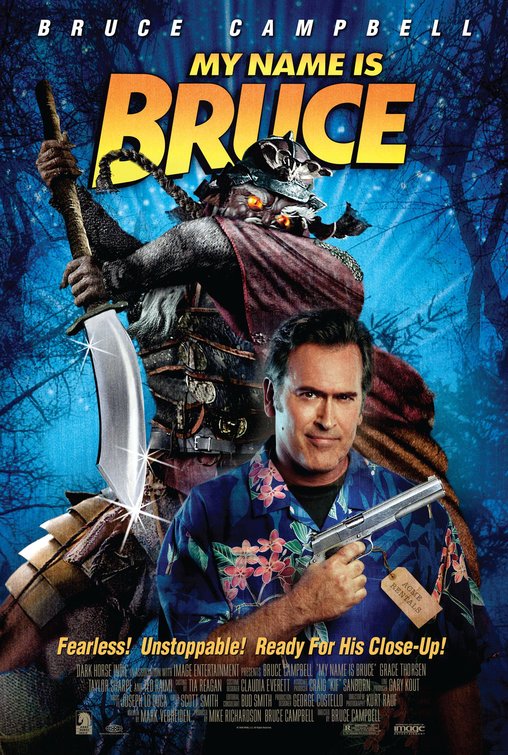
My Name is Bruce


My Name is Bruce (**1/2)

If you don't know who Bruce Campbell is, the long and short of it is that he's the quintessential B-movie actor. He's garnered a cult following mainly because of Sam Raimi's splatter-fest Evil Dead movies, along with a handful of other sci-fi/horror movies with even more ridiculous premises (Exhibit A: Maniac Cop -- "You have the right to remain silent... FOREVER!"). In My Name is Bruce, Campbell directs himself starring as himself (well, a caricature of himself) in a movie that's mostly making fun of himself. Its party a tounge-in-cheeck homage to B-horror movies, compltely with low-tech and not very convincing effects, and partly just Bruce Campbell having fun acting as if he's a complete washed-up deadbeat. Its a movie that's pretty rough around the edges, and not all of the jokes that get thrown out really work, but it is mostly enjoyable, and a mere 90 minutes long, so even if you hate it you don't have to put up with it for long.

The plot is almost too ridiculous to even go into, but, long story short, a teenage Bruce Campbell fan from the tiny mining town of Gold Like, Oregon is in the middle of a horror movie staple, a late-night romp through a foggy graveyard with a couple of girls for no real reason, when he unwittingly unleashes the ancient Chiense war God, Guan Di. Turns out that the graveyard houses the bodies of Chinese miners who were killed in a mining accident a hundred years ago, and a hex was put on the graveyard so that Guan Di would come and decapitate anyone who disturbed it. I think. Its not really completely clear and it doesn't really matter anyway. The point is an evil 8 foot tall Chinese God with glowing eyes and a big-ass halberd has been awakened and is pissed off. At any rate, Guan Di is loose and terrorizing random citizens of Gold Lick, and so Jeff, the aforementioned teenager, decides that the best solution is to kidnap Bruce Campbell, evidently working under the theory that a career of fighting fake movie monsters makes him qualified to fight an actual one. Bruce assumes that the monster is fake, and that the entire town is all in on an overly-elaborate prank by his agent.

That's pretty much all there is to say about the movie. In between the main plot concerning the all-important showdown with Guan Di, we see Bruce Campbell lampooning his career and himself in various ways: everything from Bruce on the set filming his new movie "Cave Alien 2" in which his character gets sprayed with yellow alien blood that's clearly dumped on him by a hand visible in the shot, to Bruce going home to his busted-up trailer where the mailbox is stuffed with adult magazines and he has flasks of booze stashed in every concievable location. Some of the gags are funnier than others. Bruce Campbell's comedic timing is generally excellent, although things are little more hit and miss with the supporting cast, many of which are bit players from Bruce Campbell movies of yore. There's a lot of old-school, Three Stooges-esque slapstick, which may lead to some eye rolls for those wanting something a little more clever and original. I think most everyone will find at least something to like, though, in the quick, silly, 90 minute movie that is My Name is Bruce.

Monday, May 11, 2009

Star Trek


Star Trek (***1/2)

Reviving old franchises with new movies is very much in vogue right now, and so it likely didn't come as much of a surprise to anyone when it was announced that a new Star Trek movie was in the works featuring new actors stepping into the shoes of the original crew. Less predictable, perhaps, was the manner in which it would return. Not quire a full Batman Begins or Casino Royale style "reboot," the movie instead uses a time-travel plot device to keep the story in the same "universe" as the original series, while changing the circumstances by which the crew came together, and, in one case, actually having a character meet his older self. Directed by J. J. Abrams-- who has seemingly become a household name now with the massive successes of his brainchild "Lost", and another big event movie, Cloverfield--the movie sets aside a lot of the technobabble, space-archaeology, and long-winded philosophical and ethical debates that often seem to go hand-in-hand with the series. In their place, he sets up a much louder, more action-oriented, more confrontational, and more operatic movie than we're used to seeing under the Star Trek moniker. Still, the movie is aware of the history that its building on (or, I guess, rewriting in this case), and while I imagine many of the die-hards who have been dressing up as Spock at conventions for the last 20 years will be put off by the movie's more simplistic, less science-y veneer, I thought that it struck more or less the right balance, and I think most others will as well. Its certainly entertaining.

The movie opens aboard a Federation ship that James Kirk's father, George, is serving on. James Kirk's mother is elsewhere on the ship, busy giving birth to him, when a giant Romulan ship appears seemingly out of nowhere and opens fire. Romulan's demand that the ship's captain come aboard their ship via a transport shuttle, and so the elder Kirk is left in charge in his absence. The captain doesn't come back alive, and so George Kirk is left in command, and goes down with the ship, going a good enough job of stalling to allow the rest of the ship's passengers, including his wife and just-born son to escape. We flash forward a few years later, and see that James Tiberius Kirk was quite the rebellious child, as he goes joyriding in his step-fathers car in a scene that will probably go down as the only time in Star Trek history that the Beastie Boys have been featured. Eventually, as he reaches physical if perhaps not mental adulthood, Kirk meets Captain Pike, the soon to be helmsman of the newly completed Starship Enterprise, after getting into a barfight with a bunch of his cadets. We get the somewhat cliched "Yeah, you're a reckloose, but I know there's potential in you because I know who your father was" conversation, and Kirk eventually agrees to join Starfleet Acadamy. In the meantime, on Vulcan, a young Spock makes a similar decision to join Starfleet, declining an invitation into a prestigious vulcan science guild, mainly because he was tired of being chided about how being half-human made him somehow weaker. Throw in a Bones McCoy, an Uhura, and a Checkov along the way (it takes a little while longer for Scotty to show up) and voila, you have the original Enterprise crew.

How closely the new interpretations of these characters matches the original varies from actor to actor. Chris Pine gives Kirk some of that certain swagger and brashness that he had in the old series, but stops short of trying to emulate William Shatner's oft-parodied "I'm going to put emphasis on whatever the hell words I want to in a sentence and you can't stop me" manner of speaking. Zachary Quinto, probably best known as playing Sylar on "Heroes" looks a lot like a young Leonard Nimoy, but gives Spock a certain arrogance to his whole "everything I do is dictated by logic" routine that I don't think was there before. Karl Urban, on the other hand, pretty much just tries to be the living embodiment of DeForest Kelly's old Bones McCoy, playing up all of his mannerisms to the fullest, from his inquisitive raised eye-brows, to his seemingly constant manic, bug-eyed, "I'm one step away from flipping out" demeanor. I think its almost too much, and when McCoy intentionally drugs Kirk to sneak him aboard a mission that he's supposed to be banned from, the movie becomes as slapstick as Star Trek has ever been, but damn is it fun to watch. The movie's villian is Nero (Eric Bana): the Romulan captain of the ship from the beginning of the film, who comes back 25 years later after killing Kirk's father to again do battle with a ship that Kirk wasn't supposed to be captain of but eventually ends up being just that. Nero is really only developed enough to explain what his motivations are, and certainly will not ever be mentioned in the same sentence as the nigh-universally agreed upon ultimate Trek villan Khan (or should I say KHAAAAAAAN). Said motivations have to do with the future destruction of his home-world Romulus, the circumstances of with don't really make a whole lot of sense. Really, Nero's whole plan doesn't make a whole lot of sense either in that it doesn't really solve the initial problem of his planet going kaput, and I guess it just has to be assumed that he's really pissed off and too blinded by revenge to really think things out. Nero is somewhat intriguing in the beginning of the film when he's cloaked in mystery, but as is so often the case, he becomes less interesting of a villain as we see more of him, and there really isn't all that much interesting to see here.

A whole bunch of the old series' oft-used elements show up here, presumably mostly meant as homages; thrown in with a wink and a nod. Kirk messes around with a voluptuous green-skinned alien woman, a redshirt gets killed as part of a dangerous away team mission while all the major characters survive, McCoy has at least three variations of "Dammit Jim, I'm a doctor!" that I counted, and Scotty even throws in an "I've given 'er all she's got Cap'n!" As I said earlier, though, a lot of the heady, long-winded asides that Star Trek has been known to delve in to, especially once it reached the "Next Generation" era, are pretty much absent here. I'm not necessarily sad that they're gone, as even though they were interesting when they were done well, they often detracted from the suspense of the main plot (would you be more interested in a climactic battle with the borg, or a meandering debate on how best to interpret the Prime Directive?) I think sometimes, though, J. J. Abram's vision goes too far in the other direction, mostly content to settle into the "a wizard did it!!" mentality, as ships are sucked into black holes and characters haphazardly jump around in space-time. Whereas George Lucas created Star Wars to basically be a tribute to old swashbuckling adventure movies that took the tried and true formula from said movies and put it in the setting of outer space, Gene Roddenberry's Star Trek was always somewhat grounded in science, even if it was fictional science. I'm not sure that Abrams's pretty simplistic movie really holds true to that vision. With that said, if you don't own a mint-in-box Spock action figure that you bought at a Star Trek convention in 1983, you might not really give a damn about all that and just want to see an entertaining movie. The 2009 iteration of Star Trek--in all its loud, bombastic glory--is very much just that.

Thursday, May 07, 2009

More pitching weirdness and the eternal struggle for the DH

In my last Cubs post, I mentioned how odd it was that Luis Vizciano, who the Cubs had signed to a $3.5 million deal in the offseason, was designated for assignment in order to call up Jeff Samardjia from AAA. The bullpen was going through quite a rough patch at that point--and really still hasn't perfromed as well as one would like--so its easy to see why Lou Pinella and Jim Hendry would want to make a change, but it certainly seemed like a drastic one, especially considering that the team supposedly signed Aaron Miles and let go of Mark DeRosa because of money issues. The difference between Miles and DeRosa, I believe, is only a few million dollars, and here we see the Cubs essentially paying Vizciano 3 1/2 million bucks to basically pitch for two weeks (two weeks in which, for the record, his ERA was 0.00, although I believe he let in some inherited runners). Letting go of DeRosa looks more and more confounding.

Vizciano was officially relased on Monday (bottom of this story), so he's not coming back. The thing is, since getting called up, Samardija has been knocked around quite a bit, and he has now been sent back down again in favor of Chad Fox. I don't think Vizciano was going to have a zero ERA all year. Throughout his career, he's been kind of an average reliever, probably a little better than what you'd consider "replacement level," so I wasn't expecting amazing things about him. However, I have sincere doubts that Chad Fox, who is now 38 and whose career was pretty much over due to a series of major injuries before he got an opportunity to come back with the Cubs, is going to be any better. I'm not sure if the Cubs badly overestimated how much Samardija was ready for the majors or what, but they really shouldn't have put themselves in a position where you're paying a guy $3.5 million to do nothing and then replacing him on the roster with an old, debilitated Chad Fox. Vizciano was never going to be a regular back-of-the-bullpen guy or anything, so maybe this isn't really a huge crisis, but it does look pretty silly on the Cubs' part.

Update: Since I first starting writing this on Thursday (its now Monday), Chad Fox has now been put on the DL with his career once again in jeopardy. In 2 appearances he had a 135.00 ERA. See why this was a bad idea?

------------------

Meanwhile, something which has caused a major freakout amongst Cubs nation has been the injury to Carlos Zambrano, who is going to be out for at least a couple of weeks after pulling his hamstring running out a bunt. Zambrano was safe on the play, and even though he had to be pinch-run for, his run was one of 4 driven in on a tie-breaking Derrek Lee grand slam later that inning. The Cubs ended up winning the game 6-4. In spite of this, starting immediately after the game, a faction of Cubs fans started blaming Zambrano for getting hurt, dreaming up an unwritten rule of baseball that pitchers should never try to bunt for a hit because of the risk of injury. The whole idea of this is pretty bizarre to me. Of course, running out a bunt has the potential for injury, but so does a lot of stuff in baseball. If Zambrano would've swung away on that at-bat and hit a grounder that one of the opposing infielders had to make a diving play to keep in the infield and then throw to first from his knees, is he not supposed to run that out either? If he's in the field, and Derrek Lee has to dive to make a play on a sharply hit ball down the foul line, should Zambrano not run full-out to get over to cover first base?

The point is, the line drawn by fans here as when its not right to "try" on a play, is totally arbitrary. There are many valid criticisms of Zambrano, like his famous temper on the mound that once boiled over into a fist-fight with Michael Barrett, but one thing Zambrano's never been accused of, and for good reason, is not caring enough. This play should be no different. That he cares enough to try and leg out a well placed bunt-and succeed in doing so in an inning that eventually leads to a grand slam--should be celebrated, not criticized. You'll often hear it said that pitching is an inherently unnatural act for the human body. When you consider how many pitchers at some point need major surgery because of a ligiment tear in their elbow or something of that ilk, or see pitchers who get hurt and then lose about 5 miles off of their fastball when they come back and are never really the same pitcher, its easy to believe that statement.

Weirder still, is this Phil Rogers column using the Zambrano injury as evidence that the NL needs to adopt the DH. It seems like most everyone who follows baseball has strong opinions on the DH, one way or another. Either they advocate both leagues using it or both leagues not using it. Having one league use it and one league not seems to bother a lot of people. Personally, its never really bothered me. Its one of the things that makes baseball unique to other team sports, along with each ballpark having its own dimensions. Why should ballpark dimensions be different from place to place but not DH rules? If you believe the MLB needs to have "the standard set of rules that exists in the NFL, NBA and NHL," shouldn't the playing field dimensions always be the same? I like the fact that you can watch two different styles of play on any given night, especially in Chicago with both the Cubs and White Sox on local TV. Even if you're like Rogers, however, and really want the DH implemented, I'm not sure how the Zambrano injury really ties into that all that much. As I already wrote, pitchers can get hurt doing most anything on the field, as can any other player. I'm not sure how you can eliminate pitchers batting and say "Okay, now we've ensured that we've gotten rid of all the pitching injuries that weren't really supposed to have happened." And how about telling Micah Owings that pitchers shouldn't hit.

Tuesday, April 28, 2009

Curse of the Golden Flower


Curse of the Golden Flower (***)

I didn't know it until I read it yesterday, but it certainly didn't surprise me to learn that the Opening Ceremonies to last year's Beijing Olympics were directed by the same person who directed Hero, House of Flying Daggers, and Curse of the Golden Flower, Zhang Yimou. The ceremonies wowed people all over the world, as they were massive in scale and the planning and coordination that went into them seemed nearly impossible. Whereas America was content to honor Muhammad Ali and allow him to deliberately walk his way over and light the Olympic torch during the '96 games in Atlanta, Yimou had dudes running sideways along the top of the stadium while seemingly thousands of people played drums in sequence. Yimou's movies have a lot of scenes that evoke the same feeling. They pay homage to the long-running tradition of Chinese wire-fighting movies, where every character seems to have a God-like aura and basic of physics are pretty much a passing triviality. Yimou takes full advantage of modern day CGI technology to play up this concept as much as possible. There's no such thing as one archer shooting one arrow in a Zhang Yimou movie. Rather, there's going to be arrows being fired, they're going to be fired all at once from a seemingly endlessly sized army, moving in a robot-like unison, and about half of them will then be cleaved in two in a split second by one of the main characters waving his halberd around. The thing is, even with these orgies of visuals going on, Hero and House of Flying Daggers managed to be extremely good movies with very deep characters who form intimate relationships. Hero presents itself as a deceptively straight-forward martial arts movie and manages to tell a compelling mystery while exploring questions of morality and dispensing nuggets of zen-like philosophy. House of Flying Daggers told a classic tragic love story in a visually interesting way that still managed to remain deeply personal. Curse of the Golden Flower has many similar visuals as its predecessor, and in some scenes outdoes them in their technical impressiveness, but the underlying base of the film just isn't really all that interesting by comparison.

The movie takes place almost entirely within the confines of the Forbidden City during the Tang Dynasty, which I believe is named such due to the prevalence of artificially flavored orange drink in China at the time. The current emperor is Ping (Chow Yun-Fat), who at first glance seems to be, if nothing else, a strong and capable leader. Early on though, we begin to realize that Ping has some skeletons in his closet, although, based on what we see of the inner-workings of the Forbidden City in the movie, he probably doesn't actually have a closet, but rather organizes his clothes using some strange, giant device that requires about 50 servants to operate and maintain. Prince Jai, Ping's first born son and heir to the throne, has just returned from "the frontier" as the film begins, and, after an impromptu father-son sparring match, Ping seems pleased with his progress as a fighter and leader. The Emperor's second son, Prince Wan, meanwhile, has remained within the walls of the Forbidden City, and has apparently spent most of his time while his brother was away doing the horizontal monster mash. He's had a quasi-incestuous relationship with the woman who is not his birth mother, but is the current Emperess (Gong Li), and his now secretly involved with the daughter of the Imperial doctor. He seems to have somewhat of a rivalry with Jai for who should be the true heir to the throne. There is a third son as well, Yu, who seems quieter than his older siblings at first but not because, we learn later, he has no opinion on any of the goings on in his family.

Not long after all this is set up, we get the main hook of the story: Emperor Ping is secretly hiding a slow-acting poison in his wife's "medication" for anemia. He goes to great lengths to hide this, but not great enough, and the Empress's discovery of her husband's plot against her leads to a power struggle, and divided loyalties amongst the sons. The conflict comes to a head on the night of the start of the Chrysanthemum Festival, (they don't really explain the significance of this celebration) when the Forbidden City erupts in violence between the various factions loyal to different members of the royal family. These action scenes are quite amazing in their technical excellence, and at times rival some of the Lord of the Rings battles in their sheer size, and in the amount of what is going on in a single shot through the use of CGI. However, for all the care that went into making them, I thought there was a certain hollowness to them.

What bothers me most, I think, is just how much outward destruction is caused through the royal family's very insular conflict. In the various stages of the climactic battle, we see assassins perched on the ceiling swiftly cut through about a dozen unsuspecting soldiers using metal scythes connected to ropes that they throw, soldiers getting impaled as they try and breach a spiked wall that's been set up in the city courtyard, and basically get killed in all sorts of other creative ways. In one part in particular, I couldn't help but think of the Dynasty Warriors games, as Jai continuously slaughters a host of troops who have surrounded him and are attempting to capture him alive. Their tactic of just sort of gradually trying to inch toward him in lock step clearly doesn't work, but they just sort of mindlessly continue doing it, as if that's the only think they know how to do, like a particularly slow-witted AI controlled soldier in a video game.

After the battle is over, we see servants pour out from every direction, to roll out new carpets to replace the blood-soaked ones, and to put out new chrysanthemums, since a bunch of them got knocked over during the battle. None of the servants nor any of the soliders give any clear evidence that they really know the full extent of what's going on, or that they really care at all about the royal family's issues. The battle doesn't really seem to mean anything for them, except another hurdle that they're going to have to get over while they do their duty paying deference to their leaders and setting up for the festival. Its probably true that throughout much of Imperial China, and probably through out much of the history of any country led by divine royalty, that the actions and motivations of the royal family often weren't in the best interest of the "common-folk." I'm not saying that the movie isn't accurate in its depiction. But what bothered me is that there isn't really a voice for the common person in the movie. The only characters outside of the royal family who are developed at all, are the Imperial Doctor, his wife, and his daughter, and in their case its only because they all have a role in the subterfuge going on within the Emperor's family. All the other countless people within the walls of the Forbidden City just sort of run around as specks of CGI, their purpose being nothing except to be virtual stagehands, moving props around during battles the meanings of which are only significant to a few select people, and maybe get killed in the process. Even beyond the sort of moral hazard that this creates, the movie just has a clostrophobic feel to it. Some of the best scene in Yimou's pervious works were scenes like the bamboo forest chase in House of Flying Daggers. Here there's a similar scene after the Imperial Doctor is promoted to governor of an outlying province and ends up getting chased on horseback through a mountainous region. Its probably the most exciting scene in the movie, there's just not enough of it.

The power struggle for the throne and for the life of the Emperess was an interesting enough plot to hold my interest, but I just didn't feel that the sum total of the movie was as substantive as Yimou's other movies. Hero had a lot of the same CGI-driven battles, and in much the same way focused only on a few central characters while the commoners toiled around them, but I found Hero to be a much more thoughtful and more interesting movie. A cental part of Hero is a scroll of calligraphy Jet Li's character gives to the Emperor, (different Emperor, obviously) the character on which is one of 20 different ways to write the word "Sword." The Emperor studies it and has a revelation about what it represents and what sort of beliefs about the nature of combat Jet Li's character holds. To me, that was more interesting than anything said by Emperor Ping or any other character in Curse of the Golden Flower. There is a scene in Curse where the family is sitting around eating a meal ceremoniously, and Ping explains how the layout of the elaborate table and carpeting that they're sitting around represents the universe, which seems like its going to head down the same path as the calligraphy scene in Hero. It shows up again at the end of the film, but the symbolism there seems kind of obvious and not very deep by comparison. If I watch Curse more, I may notice things that I didn't initally that change my view of the movie, but my first impression was that it doesn't have quite the impact that either Hero or House of Flying Daggers has.

Curse of the Golden Flower is an entertaining movie. There are some beautiful and technically impressive shots, the story will hold your interest, and the music and cinematography similarly interesting. If I had to pick one film to represent Zhang Yimou's work, though, out of what I've seen, I likely wouldn't pick this one.

The Bradley Effect


If you had somewhere around 15 games in your "How long will it take Cubs fans to get pissed off at Milton Bradley?" pool, congratulations, because you win. Bradley is still nursing a groin injury that he suffered on April 12th against the Brewers. On April 22nd, he started in right field and by all accounts he seemed poised to jump back into the every day lineup, but went 0-for-4 with 3 Ks and wasn't running at full speed, and so he has again been relegated to the bench. He has been used sporadically as a pinch hitter, and in one such appearance he made physical contact with an umpire arguing balls and strikes and got hit with a two game suspension. For reasons unbeknownst to me and most everybody else, he has decided to appeal the suspension, even though he could easily have served the suspension while being out with a groin injury with no real added detriment to the team. While he's managed to draw some walks, he's just 1-for-21 hitting, so yes, he has less base hits than he has games suspended as a Cub. Meanwhile, Bradley's contentious relationship with the media, something he was known for in Texas, appears to have manifested itself in Chicago, as Bradley accused the media of taking his quotes out of context and turning the fans against him, even though he didn't really seem to have a specific example of this actually happening. As I'm finishing writing this, the Cubs are playing out in Arizona and Bradley is in the lineup again. We'll see if he stays there this time. 0-for-1 thus far.

The Cubs also recently brought up Jeff Samardjia from AAA and, somewhat curiously designed Luis Vizciano for assignment for the corresponding move. In truth, there weren't a lot of other attractive options. Angel Guzman is out of options, so he pretty much has to stay up, as does David Patton, who is a Rule 5 pick from the Rockies, which means that he goes back to Colorado if the Cubs don't keep him up. But not only had Vizciano not allowed an earned run yet, he was also just signed at the start of the season for $3.5 million. Its possible that Vizciano doesn't get picked up by another team (I want to say that you can pick up a guy that got DFAed for half of his salary, or something along those lines), accepts assignment to the minors, and eventually makes his way back to the Major League club, but as of right now, Vizciano essentially made $3.5 million dollars for pitching 2 weeks. The rightys in the bullpen have certainly been pretty shaky with the exeption of Carlos Marmol, but the biggest issue in the bullpen right now is Neal Cotts, the Cubs' sole lefty. They've been trying to bring him in situationally against leftys in close games, but he's had a ton of problems with walking people. Some people have suggested that Samardjia should go to the rotation so Sean Marshall can head to the bullpen and become a left-handed situational guy. This would seem to be a little extreme, if you ask me. Marshall has looked okay so far as a starter, with a decent-by-5th-starter-standards 4.91 ERA, and Samardjia got roughed up a little bit in his first appearance since getting called up. There doesn't seem to be many good options available though. It wasn't too long ago that the Cubs were carrying 3 leftys in the pen and couldn't find innings for all of them.

Friday, April 17, 2009

The Many Moods of Kosuke

The Cubs are currently 5-4, which may be somewhat underwhelming given their high expectations and the relative weakness of the rest of the NL Central, but, while some of the losses have been quite frustrating, none of them have really disturbed me all that greatly. The bullpen has had some early issues, which Kevin Gregg being less than lights out in the closer's role, and the hitting has been very up and down, but ultimately I haven't seen anything in the nine games played thus far that radically changes my outlook of the team. Geovany Soto has been banged up early on (maybe a product of playing in the World Baseball Classic) and is hitting just .071. You would certainly expect him to heat up. Milton Bradley is also battling a groin injury (of course, Bradley being achey at times during the year was something fully expected going in) and has hit just .056, though he has been able to draw some walks in key situations, and has had enough good ABs to say that he's been helping the club.

One very positive thing amongst the somewhat luc-warm start has been the play of Kosuke Fukudome. Kosuke already has 3 home runs on the year, including a three-run shot yesterday against the Cardinals which, at the time, gave them the lead, though they couldn't hold it. Fukudome wound up with only 10 home runs for all of last year. Of course, early in the season was when Fukudome was at his most brilliant last year, and he's output got progressively worse as the season went on. Will the same thing happen this year? Who knows. What we can do now, though the mighty power of Baseball Reference, is compare what Kosuke did at the start of last season to what he's done 9 games into this season. With a sample size of 9 games, who knows how much its really worth, but whatever, it'll be fun!

Through 9 games:


stat20082009
Avg.371.375
OBP.488.487
Slg.543.781
OPS1.0311.268
HRs13
RBIs68
K64


The power numbers are actually better, and the average and OBP are very close. Maybe, just maybe, that with Fukudome-san having a year to get acquainted with the increased travel in the MLB and playing outdoors (lots of domes in Japanese baseball, so I'm told), he'll be able to maintain this pace more consistently throughout the year. Maybe wishful thinking, but it doesn't seem impossible either.

Today the Cubs are playing the Cardinals with Carlos Zambrano on the mound against a 24 year old making his Major League debut. If they lose their third in a row today given these circumstances, I'll be a little bit more down on them than after any of the 4 losses to this point. Whatever happens though, its still very, very early yet.

Thursday, April 16, 2009

Street Fighter IV


After being very underwhelmed by the whole experience of Prince of Persia, when I perused the shelves in Best Buy a few weeks ago, I decided to pick up a game where there wouldn't be a lot of mystery as to what I was going to get. As such, I ended up settling on Street Fighter IV. I'm not really what I would consider a veteran of tournament fighters, and the one series that I've gotten reasonably deeply into--Soul Calibur--differs quite a bit from Street Fighter. I did own and played a fair amount of Marvel vs. Capcom 2, though never really got particularly good at it. So basically, I'm going into Street Fighter IV mildly aware of the basics of the game, though certainly still at a novice level (this was confirmed a couple of weekends ago playing my friend who used to play SF Alpha 2 competitively, and getting pretty consistently owned).

The biggest and most immediately recognizable difference from the classic SF games is the use of fully 3D models for characters instead of 2D sprites. Its still a 2D fighter, but its now 2D fighting in a 3D environment. Despite the switch, the game still retains most of the same feel that the earlier 2D iterations of the series had. The visuals look detailed enough to warrant being on a next-generation system, while still retaining some of the exaggerated anime-ish quirks that have been a trademark of the series. Chun Li's kicks still inexplicably create neon blue trails of light, E. Honda's fists still fade into a Loony Toons-esque blur, etc. I always thought Street Fighter II had a better look and feel to it compared to its once direct competitor Mortal Kombat, which used sprites that were generated from captures of real people dressed up like the characters. While, understandably, the MK characters looked more like real people in still shots, I thought in the context of the game the MK graphics looked rigid and awkward, while SF's "cartoonyness" allowed it to be more fluid. But even in an era where 3D motion capture is commonplace in game development, I don't think these little flourishes of exaggeration feel out of place and still have a certain charm to them.

The core gameplay elements have remained pretty much true to what its always been, and veteran players will be able to recognize that a lot of the basic button combinations are still the same. A hadoken is still down, forward, punch, for example. Borrowing from the Alpha and MvC era games, the game gives each fighter an "EX gague" and a "Revenge gauge." The EX gague can be used to pull of "EX" versions of certain moves, which you can do by simply adding another punch or kick button at the end of the move. If it fills up all the way, you can try and pull off your Super Combo, where everything on screen turns into an orgasm of anime speed lines. Your Revenge Gauge is used for your Ultra Combo, which is generally an even more powerful version of the Super Combo, and is usually done with the same button combination, only with all three punch/kick buttons at the end. They also added a new charge-up move that you can use with each fighter for which you hold down medium punch and medium kick simultaneously. As the move is charging up you can absorb one hit from your opponent, and if you're able to get it off and land it, it'll do a big chunck of damage and stun your opponent.

As I said above, I'm not good at all against a veteran human opponent at this point, but against the computer I feel as if I'm slowly improving. It certainly isn't too difficult to start playing from scratch and have at least some base level of effectiveness against the CPU on low difficulty without hours and hours of effort. The game has the traditional tournament fighter training mode, wherein a dummy oppnent just kind of sits there as you beat the crap out of him. It also, however, has what it has a "Trial" mode which is basically a much more sophisticated version of the basic training mode idea. With each character you try and pass five separate levels, in which you first try and execute the character's basic movies, and then move on to pulling off sophisticated combos. You unlock artwork doing this, so you feel like you're accomplishing something as you're learning. I thought this was a great addition, and I'm not sure why they felt the need to bury it in the Challenge Mode menu alongside the not at all related Time Attack and Survival Modes.

The game brings back most of the old mainstays of the Street Fighter series, and introduces some new ones as well. They range from Abel, a very serious looking mixed martial artist, to El Fuerte, a completely off the wall masked luchador character who, in his opening cutscene, explains that he aspires to become a chef and that he's joining the tournament to get recipies from the other fighters. Another new character, Rufus, as an obese, loudmouthed American (is it just me, or does it seem like there's some no too subtle social commentary about Americans in the Street Fighter games) is also supposed to be funny, but if you ask me, he's more annoying than anything else. Having read through some of the official strategy guide and elsewhere, it doesn't seem like any of the new characters are all that effective at a high level, but their move sets are often pretty unique (El Fuerte has one sprint that he goes into where he performs six different moves coming out of it based on the attack button that's pressed after its started) and should serve to keep the game fresh over a long period of time.

After Prince of Persia, I basically just wanted a game where I knew going in exactly what it was going to basically consist of. Street Fighter 4, indeed, sticks to the basic formula that its been doing for well over a decade now, but adds enough new elements and polishes up the look enough to justify it being on PS3 and X-Box 360. If you love tournament fighters, well, you probably already know about SF4, but if you don't, you should run out and pick it up.

Wednesday, April 08, 2009

Early Returns

The first two Cubs games of '09 are in the books, and they'll finish out their first series tonight at Minute Maid Park in Houston. After winning the opener 4-2, the Cubs lost last night 3-2 in 10 innings. Starters Carlos Zambrano and Ryan Dempster both looked very good for their parts, the difference being that Dempster simply got more fun support. Even if Dempster regresses a little bit from his career year last year, there's no reason to believe that this rotation won't be right near the top of the NL. Kosuke Fukudome went 0-for-4 with a strikeout and grounded into a double play in the opener, and really didn't do anything to instill confidence that his 2009 season will be more like his first half of '08 than the second. Aramis Ramirez also evoked some bad memories last night, getting thrown out with relative ease by Carlos Lee playing a ball off the wall on a hit that Aramis tried to stretch from a single to a double. Ramirez has made some pretty awful baserunning decisions in the past, but hopefully that was more a result of the somewhat odd layout of the Minute Maid Park outfield and not part of a continuing pattern.

Two games does not make a season, but just because I talked about it in my last post, I suppose I'll mention what Kevin Gregg and Carlos Marmol have done. Marmol pitched the 8th inning in the opener, and allowed just a walk which he left stranded. Gregg came in to save the game and allowed a couple of baserunner, one of which came around to score before nailing down the save. Gregg then pitched the 10th last night after Neil Cotts put two men on with no one out, and failed to get out of the job, giving up the game winning hit to Jeff Keppinger. Listening to the radio this morning, people seem to already be wringing their hands in concern over this. I'm on record as saying that I think Marmol is the better pitcher, but two games is just a wee bit too small of a time frame to be evaluating whether a change should be made. Same goes for anything that people might be concerned about, frankly. Consider that the defending champion Phillies, fielding much the same team that they won with last year, are 0-2 in their opening series against the Braves, and are losing 9-3 in the finale as I write this. Really the only reason why I am writing this is because I don't have any movies to write about at the moment. Baseball season is a loooong season.

Wednesday, April 01, 2009

In Closing


The Cubs are winding down Spring Training, and will start the season proper next Monday night in Houston. Nothing terribly eventful has happened in Spring Training, which is a good thing, because really the most eventually thing you can imagine happening is someone important getting hurt. There was a bit of news earlier in the week, though, and somewhat surprising news at that, in the form of Kevin Gregg being named close by Lou Pinella. It was a decision, apparently, based largely off of their performances during Spring Training. Spring Training doesn't give you a really good sample of a player's ability to begin with, both in terms of playing time, and the quality of players they're facing, and Marmol's spring was truncated this year because he played for the Dominican Republic in the World Baseball Classic. He did blow a save in the World Baseball Classic against a team of almost entirely minor leaguers in the form of the Netherlands, but that was a) one game and b) party due to bad defense. For what its worth, their spring training stats were as follows (source: mlb.com):


IPERAHBBK
Kevin Gregg9.10.004213
Carlos Marmol9.04.0061*12

*Also had 5 HBPs.

Gregg's stats are certainly impressive, and better than Marmol's, but again, I think its undeniable that Spring Training stats have an inherent unreliability, and personally, I would've made it Marmol's job to lose. Obviously, Pinella is seeing guys work out every day, not just playing in exhibition games, but just looking at what the two did during games, I certainly don't think Marmol did anything that would make you suggest that he was going to be much less effective this year than last year, when he most certainly was playing at a closer type level, even wtih a few big hiccups along the way. Basically, if you ask me, Marmol should be the closer for two reasons:

1. I'm still pretty sure that Marmol is the better pitcher. In his career as a reliever, Marmol's ERA is 2.39 (baseball-reference.com). Kevin Gregg's best full year in the majors was last year with the Marlins, where he posted an ERA of 3.41, and its 3.90 in his career as a reliever. Marmol is also way harder to hit against for both righties and lefties. Gregg's K/BB ratio is better, and Marmol has certainly shown some control issues, but I don't think its really a big enough issue to matter in the face of how much harder it is for opponents to hit off of Marmol.

Really though, even if Gregg starts as the closer, it doesn't mean that he has to stay the closer. And even if he struggles and Lou decides to keep him as closer throughout the regular season for some reason, in theory, the Cubs should be better than the rest of the division to the point where it really shouldn't matter. What matters is whether the Cubs have someone who can be lights out to finish off a playoff game come October (provider the Cubs actually have a lead late in a playoff game this year... rrrr...). That brings me to point 2.

2. Its very much possible that Marmol will have more wear put on him as a set-up man than as a closer. Usually, the set-up man is thought of as the guy who pitches the 8th inning before the closer is going to come in to pitch the 9th. However, there were times last year, when Marmol would be brought in a jam in the 7th, have to work out of it, then continue on to pitch the 8th, sometimes batting in between that time. If you sift through his game log, you'll find a bunch of instances of Marmol throwing 30+ pitches, a couple instances of him throwing 40+ pitches, and on top of that, a bunch of instances of him throwing on back to back days. Dan Bernstein, a radio show host for 670 The Score here in the Chicagoland area, has taken to calling Marmol Lou Pinella's "blankie," because sometimes he seems to be what Pinella uses to make himself feel safe again in whatever tense situation arises, regardless of what sort of rest Marmol has had. Carlos Marmol made the All-Star team last year because he was absolutely lights out for much of the first half, but by the time the All-Star game rolled around, his ERA had ballooned into the fours and looked very un-All-Star like. It took some time for Carlos to seemingly get himself right again. A lot of people suspected this to be due to overuse at the time, and if Pinella uses Marmol in a similar fashion in this year, it'll make a lot of people, including me, nervous again.

Carlos Marmol is 26, and there's no reason why he shouldn't get even better than he is now in the next couple of years and become a perennial All-Star contender. But he's a hard-throwing power pitcher, and, while he hasn't shown himself to be injury prone to this point, all you have to do is look at the rise and fall of a pitcher like Eric Gagne to want to be weary of how much abuse you put on the arm of a pitcher like Marmol. The Cubs are trying to win now, and they should use Marmol to try and win now, but they should do it within reason, with the knowledge that he should be able to help the Cubs now AND in the years to come.